Guides
Can an Emotional Support Animal Help an Autistic Child or Adult?
What an emotional support animal is and is not for an autistic child or adult, how it differs from a trained service dog, what the research says, and how the housing letter works.

On this page
An emotional support animal is a companion, and a service dog is a trained working partner; that difference decides what the law gives you. Some autistic children and adults keep an emotional support animal for comfort, and a licensed clinician decides whether a letter for housing fits. Reviews of the research on animals and autism describe small improvements, uneven methods and a call for more study, so this guide sticks to what the rules say and what the studies report. It promises no result.
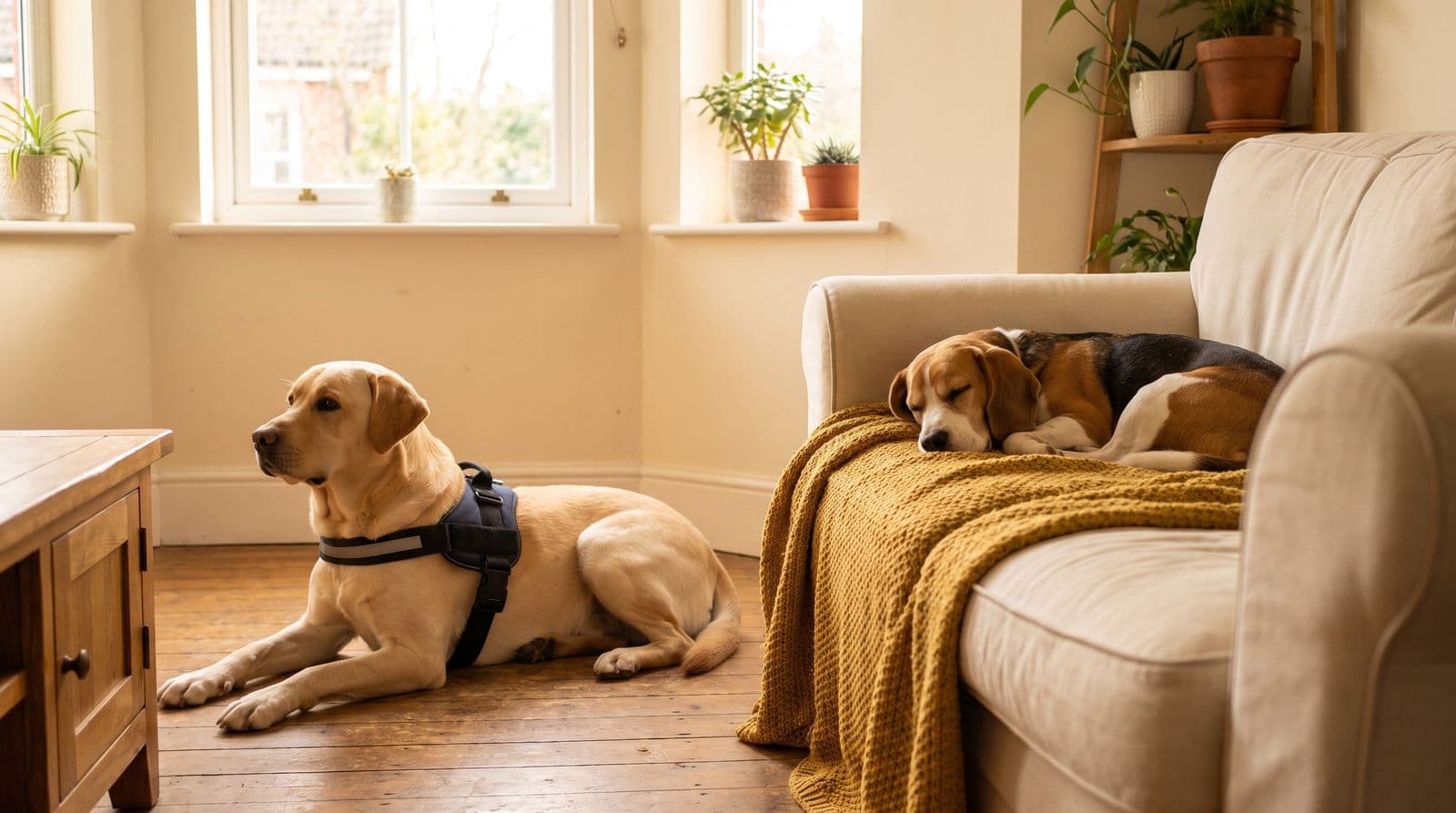
An emotional support animal
A companion with no task training. Housing is where it is protected, and a letter from a licensed professional supports the request.
An autism service dog
A dog trained to do tasks, such as keeping a child from wandering away, with the ADA's public access rights.
The wait
A 2023 study says waits for a well-trained autism assistance dog can exceed 3 years.
The letter
For a child, the letter comes from the child's own licensed clinician, and a parent can make the housing request.
An emotional support animal is a companion, and a service dog for autism is trained to do specific jobs
The Justice Department's own list of what a trained service dog can do includes "preventing a child with autism from wandering away" (ADA.gov FAQ). The ADA defines a service animal as a dog "individually trained to do work or perform tasks for the benefit of an individual with a disability, including a physical, sensory, psychiatric, intellectual, or other mental disability" (28 CFR 36.104). Emotional support animals are described differently: they "provide comfort just by being with a person," and because they have not been trained to perform a specific job or task, they do not qualify as service animals under the ADA.
| Where it matters | What the rules say for an emotional support animal and for an autism service dog |
|---|---|
| Training | Emotional support animal: none required, because the animal's company is what helps (ADA.gov FAQ). Autism service dog: individually trained to do work or tasks. One study describes autism assistance dogs as trained "primarily to ensure the safety of an autistic child by preventing elopement and mitigating 'meltdowns'" (Tseng et al., 2023). |
| Shops, restaurants and public places | Emotional support animal: no ADA right to enter, so the business's own pet policy applies, unless a state or local law says otherwise. Autism service dog: covered by the ADA. Staff may ask only two questions and may not ask for documentation. |
| Your home | Emotional support animal: the Fair Housing Act, supported by a letter from a licensed professional. HUD's May 2026 memo says its fair housing office will now pursue only trained animals (more on HUD's rules). Autism service dog: the Fair Housing Act. The same memo calls requests to waive pet policies for animals trained to perform specific disability-related services "presumptively reasonable" (HUD memo). |
| School and university | Emotional support animal: no ADA right to enter. Ask the school's or university's disability office what its own policy says. The Fair Housing Act also applies to university housing. Autism service dog: ADA.gov lists schools among the places a service dog can go, and says the ADA covers housing at public and private universities (ADA.gov). In a K-12 school, the school "may need to provide some assistance" so a student can handle the dog (ADA.gov FAQ). |
| Cost and wait | Emotional support animal: no training cost, and a letter comes from a licensed professional who evaluates you. Autism service dog: a 2023 study says average waits can exceed 3 years and the cost to raise and train one dog can surpass $55,000 (figures below). |

A trained autism assistance dog can take more than three years to arrive and costs tens of thousands of dollars to produce
3+ years
is what the study says average waits for a well-trained autism assistance dog can exceed.
$55,000+
is what the study says the total cost to raise and train just one such dog can surpass.
3 to 5 years
was the length of the waiting list at the regional provider where the study found its families.
The families in that study received their dogs free of charge from a nonprofit provider, and the authors write that the cost and time per dog "limits severely the number of dogs placed each year." What families are charged elsewhere varies. A February 2022 Kaiser Health News report found that organizations charged $15,000 to $40,000 for a fully trained service dog, bred, raised and trained for about a year and a half, and that nonprofit trainers "generally donate dogs to patients for at most a small application fee" while other trainers "have long waiting lists" (Kaiser Health News, carried by NBC News). The ADA lets people train a service dog themselves, but the dog must already be trained before it goes into public places (ADA.gov FAQ). Veterans looking at service dogs meet the same prices, and our guide to PTSD, veterans and service dogs covers what the VA does and does not provide.


Reviews of the research on animals and autism describe small improvements and ask for more study
Almost all of this research is about animal-assisted programs, such as scheduled sessions with a trained animal, and about assistance dogs. It is not about emotional support animals, which have no training or program, so it cannot tell you what a pet in your home will do. Here is what three reviews of the programs found.
85 studies
on animal-assisted intervention and autism, counted by a 2023 review, up from 42 before 2015.
16 studies
(489 children) in a 2021 meta-analysis, which found small improvements in social interaction and communication.
45 studies
(1,212 participants) in a 2024 meta-analysis, which advises caution in generalizing the results.
The reviewers' own words are measured. The 2023 review found that "issues with methodological rigor remain." The 2021 meta-analysis concluded that such programs "appear to offer small improvements in social interaction and communication for children with Autism, which may be comparable to activities used in active control conditions." The 2024 meta-analysis reported gains in some areas, social communication among them, and uncertainty in others, noting "a high risk of bias in existing studies" and "the absence of long-term follow-up data." One small before-and-after study of 11 families who received a trained autism assistance dog reported positive changes; its authors note it had no comparison group (Tseng et al., 2023). A clinician who knows your family is the right person to talk through what an animal might mean for you.
Give your companion the card
Register your emotional support animal in about 3 minutes. Your Certificate of Registration and wallet ESA Card arrive by email as two print-ready PDFs, backed by a 30-day guarantee.
About 3 minutes · Instant digital delivery
30-day money-back guarantee, no questions asked.Autism is named among the impairments the Fair Housing Act covers, and a licensed professional decides whether a letter fits
The HUD and Justice Department joint statement on reasonable accommodations says the Act's term "physical or mental impairment" includes, among other conditions, "autism" (joint statement, Q3). What counts is whether the person has an impairment that substantially limits one or more major life activities, and that is decided person by person. The statement lets a housing provider ask for reliable information that shows the disability and the link between it and the animal, and it adds that "in most cases, an individual's medical records or detailed information about the nature of a person's disability is not necessary." A letter from a licensed professional who knows the person is the usual way to give that information.
The rules for homes changed in 2026. HUD's May 22 memo says its fair housing office will find reasonable cause only for animals trained to provide disability-related assistance, while the Fair Housing Act itself, and the right to sue within two years, did not change. Our page on HUD's emotional support animal rules explains what that means in practice, and the guides to pet deposits and to Section 8, public housing and assisted living cover the next questions.
For an autistic adult, the route to a letter is the same as for anyone else
- Start with the clinician you already see, if you have one. Whether a letter fits is their decision.
- If you do not have one, a live video evaluation with a licensed professional is another route. The professional decides whether a letter fits, and in some states ESA Card can book that evaluation with an independent therapist licensed there.
- Make the request in writing. The joint statement says you need not "mention the Act or use the words 'reasonable accommodation.'" Say you are asking for an exception to the animal policy because of your disability, and attach the letter. A sample letter shows what a valid one contains.
- Add an ID card only if you want one. The ESA Card photo ID card and certificate is a convenience, and no law requires one.

For a child, the letter comes from the child's own clinician, and a parent can make the request
The Fair Housing Act bars discrimination in the terms of a rental because of the disability (the statute says "handicap") of the renter, of "a person residing in or intending to reside in that dwelling," or of "any person associated with that person" (42 U.S.C. 3604(f)(2)). So a child who lives in the home is covered, and the joint statement says that "a person with a disability need not personally make the reasonable accommodation request; the request can be made by a family member or someone else who is acting on her behalf." A parent or guardian who rents the home can make the request for the household.
The letter itself should come from a licensed clinician who has evaluated the child and knows them, such as a pediatrician, psychologist or psychiatrist.
Three questions settle which kind of animal you are really asking about
Comfort or a trained job?
Comfort points to an emotional support animal. A job, such as keeping a child from wandering away, points to a service dog.
Who cares for the animal?
Feeding, walks, vet visits and training fall to the family, whichever animal you choose.
What does the home's policy say?
Ask the housing provider for its animal policy in writing before you decide.
These are the studies, rules and notices every line above comes from
- HUD and Justice Department Joint Statement on Reasonable Accommodations (May 17, 2004), questions 3, 12 and 18.
- 42 U.S.C. 3604: the Fair Housing Act, including subsection (f)(2).
- HUD's enforcement memo of May 22, 2026 and the Federal Register withdrawal notice (April 6, 2026).
- 28 CFR 36.104, the ADA.gov Service Animals FAQ and ADA.gov Service Animals.
- Tseng et al., Journal of Autism and Developmental Disorders (2023), Above and Beyond Safety.
- Reviews on PubMed: 2023 review of the literature from 2016 to 2020, 2021 meta-analysis and 2024 meta-analysis.
- Kaiser Health News (February 2022), Demand for service dogs unleashes a Wild West market.
Give your companion the card
Register your emotional support animal in about 3 minutes. Your Certificate of Registration and wallet ESA Card arrive by email as two print-ready PDFs, backed by a 30-day guarantee.
About 3 minutes · Instant digital delivery
30-day money-back guarantee, no questions asked.