Housing Rights
To Get an ESA Letter for a College Dorm, Send a Licensed Clinician's Letter to Your School's Disability Office
A dorm request goes to your school's disability services or housing office with a letter from a licensed clinician. Here are the four steps, what the letter needs, what the law covers on campus, and what to do if the school says no.

On this page
To get an ESA letter for a college dorm, have a licensed mental health professional or physician in your state evaluate you and write it, then send it with a written request to your school's disability services office or housing office. The Fair Housing Act covers most college dorms and university housing, and ADA.gov says the ADA also applies to housing at public and private universities. Your request rests on the Fair Housing Act, because an emotional support animal is not a service animal under the ADA. Below are four steps, what the letter needs, what the law covers on campus, and what to do if the school says no.
Four steps take a dorm request from your first question to a written answer
- Get the letter from a licensed clinician. It comes from a licensed mental health professional or physician, licensed in your state, who has evaluated you. Ask a therapist, psychiatrist or doctor who already treats you, since many write one as part of your care, and hand them our free sample ESA letter. More on who can write an ESA letter.
- Contact the disability services office or the housing office early. Ask the school's or university's disability office what its own policy says, what it needs from you and who decides, and ask how it handles a roommate who shares the room. The Fair Housing Act lets you ask at any point, before applying, when signing, or after you have your animal, but an early question leaves time to fix anything the office wants changed.
- Submit the school's accommodation request with the letter attached. If the office has its own request form, use it. Either way, say you are requesting a reasonable accommodation for an assistance animal under the Fair Housing Act, name the animal, date the request and attach the letter. Leave your diagnosis out: a housing provider may not ask for it.
- Keep every message in writing and ask for the answer in writing. A dated email chain is worth more three months later than a friendly chat nobody wrote down. Silence or indefinite stalling can itself amount to an unlawful denial of the accommodation.

The letter for a dorm needs the same few things as any housing letter
A housing letter is written by a licensed professional on letterhead, says you have a disability and that the animal helps with it, and is recent. Our guide to ESA letter requirements goes through every line, and our free sample ESA letter shows the format. The four things a housing office looks for:
- A licensed professional in your state wrote it, after a real treatment or evaluation relationship with you.
- It is on letterhead, with the provider's license type, license number, contact details, signature and date. The license number is what a housing office verifies.
- It states two facts: you have a condition that qualifies as a disability, and the animal provides support that alleviates at least one symptom of it. It does not need to name your diagnosis.
- It is recent. Federal law sets no expiry, but providers customarily expect a letter dated within the past 12 months.
You do not need a registration, an ID card or a vest. There is no government registry for emotional support animals, so no school can require a number from one. A card or certificate shown alone can lawfully be declined, which is why the letter leads. Our guide to an ESA letter for housing covers what a housing office may and may not ask.
No provider yet? Community mental health centers, university training clinics and campus counseling are the low-cost routes to a clinician, and a letter that comes out of real care is the strongest kind.
No provider of your own? In Florida, New Jersey, New York and Ohio we can book you a live video evaluation with an independent therapist licensed in your state: $120, with $80 back if they can't approve you, and the therapist alone decides on the letter. You can book in Florida, book in New Jersey, book in New York or book in Ohio.

Give your companion the card
Register your emotional support animal in about 3 minutes. Your Certificate of Registration and digital ESA Card arrive by email as two print-ready PDFs, backed by a 30-day guarantee.
About 3 minutes · Instant digital delivery
30-day money-back guarantee, no questions asked.Four states add a 30-day wait before some ESA letters can be written
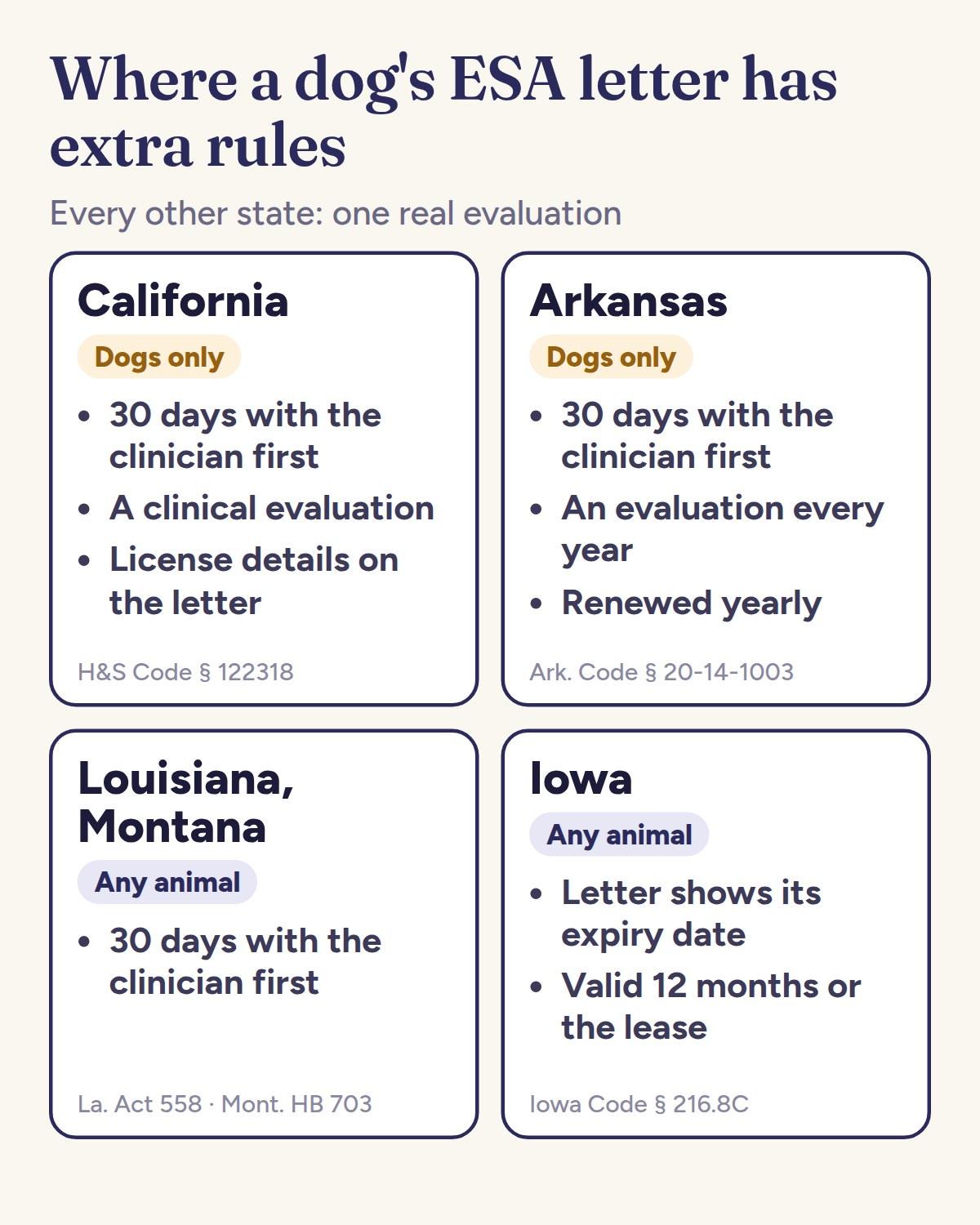
In California and Arkansas, a clinician may not document an emotional support dog until they have had a client-provider relationship with you for at least 30 days, and Arkansas also wants a yearly evaluation. Louisiana and Montana require the 30 days for any animal. Everywhere else, one real evaluation is enough. If one of those states is where you live, start early, because a letter from a provider who met you last week is one a housing office can reject. Our state law table has all fifty.
The Fair Housing Act is the law your dorm request rests on, and the ADA reaches university housing too
ADA.gov says "The ADA also applies to certain types of housing, including:" and the first item on its list is "Housing at public and private universities." Its Service Animals FAQ spells out what that means for animals, in its answer about whether residential properties must comply with the ADA:
"The ADA applies to housing programs administered by state and local governments, such as public housing authorities, and by places of public accommodation, such as public and private universities. In addition, the Fair Housing Act applies to virtually all types of housing, both public and privately-owned, including housing covered by the ADA. Under the Fair Housing Act, housing providers are obligated to permit, as a reasonable accommodation, the use of animals that work, provide assistance, or perform tasks that benefit persons with disabilities, or provide emotional support to alleviate a symptom or effect of a disability."
That answer, from the ADA.gov Service Animals FAQ (read November 26, 2026), sends the emotional support part of a dorm request to the Fair Housing Act. The ADA's own animal rule is narrower. The Service Animals page on ADA.gov, also read November 26, 2026, lists "Emotional support or comfort dogs" among the animals that are not service animals, because "providing emotional support or comfort is not a task related to a person's disability," and adds: "If the dog's mere presence provides comfort, it is not a service animal under the ADA." Our guide to whether the ADA covers emotional support animals shows the rule line by line.
Most college dorms and university housing are covered by the Fair Housing Act. Its exemptions are limited to small owner-occupied buildings, some by-owner rentals, and member-only religious or private-club housing. HUD withdrew its 2020 assistance animal notice effective September 17, 2025, and since May 22, 2026 its fair housing office pursues an animal complaint only when the animal is trained to do disability-related work. The Fair Housing Act itself did not change, courts still decide what it requires, and state laws are separate. Our page on HUD's emotional support animal rules has the details.

The laws on this page cover your dorm room, not the rest of campus
An emotional support animal in a dorm is a housing accommodation, and the Fair Housing Act covers housing. An emotional support animal is not a service animal under the ADA's rules, so it has no ADA right to enter shops, restaurants, hotels or offices. For a classroom, library or dining hall, ask the school's or university's disability office what its own policy says. The Justice Department's FAQ also notes that "some State or local governments have laws that allow people to take emotional support animals into public places," so a state or city can go further than the ADA.
A dog individually trained to do work or tasks for a disability is a service animal, a different legal category, and ADA.gov lists schools among the places a service dog can go. Our guide to psychiatric service dogs and emotional support animals shows how the two compare.
Inside the dorm, the rest of the rules still stand. A no-pet policy does not become void when you ask for an accommodation: your animal becomes an exception to it, a roommate's ordinary pet is still barred, and conduct rules on leashes, waste and noise apply to your animal the same as to any other in the building.
If the school says no or does not answer, ask for the reason in writing
If the school refuses your request or ignores it, ask for the answer and the legal exception it relies on in writing, point it to the license number on the letter, and go to your state's fair-housing agency if it cannot name one.
- Ask for the denial in writing, along with the exception the school claims. "Policy" is not a legal basis. The lawful grounds are narrow: an exempt building, a direct threat or real damage from your own animal, an undue burden, or documentation that is not credible. Our guide to when a landlord can deny an emotional support animal lists them.
- Invite verification. Give the office your clinician's name and license number and let it check them. Many refusals dissolve once the office confirms the clinician is real and licensed. Our guide to how to verify an ESA letter shows the checks.
- File with your state fair-housing agency. Most states run one, filing costs nothing, and many enforce state laws broader than the Fair Housing Act.
- Consider a private lawsuit. The Fair Housing Act lets you sue in state or federal court within two years of the denial. You can still file with HUD within one year, but since HUD's May 2026 enforcement memo its fair-housing office no longer pursues complaints over untrained emotional support animals, so do not make that your only move.



Alongside the letter, ESA Card registration gives your animal a digital ESA Card with its photo, a certificate and a number anyone can check at esacard.com/verify, for $39$59$79$99 once, in about three minutes. It is handy for everyday questions and it is optional: the letter is what the housing office reads. If you are a college student living with an emotional support animal, ESA Card also runs a scholarship for students like you.
These are the pages and guides every line above comes from
- ADA.gov, Service Animals, read November 26, 2026: the ADA applies to "Housing at public and private universities", the "Other laws apply to housing" section, and why emotional support or comfort dogs are not service animals.
- ADA.gov, Service Animals FAQ, read November 26, 2026: question 35 on residential properties and the Fair Housing Act, and question 3 on state and local laws that allow emotional support animals into public places.
- Our guides to the Fair Housing Act and emotional support animals, an ESA letter for housing, who can write an ESA letter and whether the ADA covers emotional support animals, each of which links its own sources.
Give your companion the card
Register your emotional support animal in about 3 minutes. Your Certificate of Registration and digital ESA Card arrive by email as two print-ready PDFs, backed by a 30-day guarantee.
About 3 minutes · Instant digital delivery
30-day money-back guarantee, no questions asked.