Housing Rights
Verify an ESA Letter by Looking Up the License and Asking the Provider
There is no national emotional support animal registry to check. A letter is verified through the person who signed it: their license, their identity and one question to them. The four checks, with the lookup links for five states.

On this page
There is no national emotional support animal registry to check a letter against. A letter is verified through the person who signed it: whether they hold the license they claim, whether they are who the letter says, and whether they confirm they wrote it. This guide walks through those checks in order, for a landlord, a leasing office or a tenant who wants to know what will happen to their letter. It is based on what the state boards, the federal NPI Registry and the two biggest screening services publish themselves, read on October 25, 2026.
A letter is verified through its provider because no national emotional support animal registry exists
OurPetPolicy's resident help center says it plainly: states have no system to certify assistance animals, and there is no federal certification process either (help center). Florida's statute goes further for its own landlords: an emotional support animal registration of any kind, "including, but not limited to, an identification card, patch, certificate, or similar registration obtained from the Internet is not, by itself, sufficient information to reliably establish that a person has a disability or a disability-related need" (Fla. Stat. § 760.27(3)(c)).
That is why the checks below all run through the provider. It also settles what a number lookup can show. Our verification page takes an ESA Card registration number and confirms that we issued it and whether its listing is active, lapsed or not active. It shows only what is printed on the card, and it says nothing about a disability, because a card number is not where a disability is documented. The letter is.
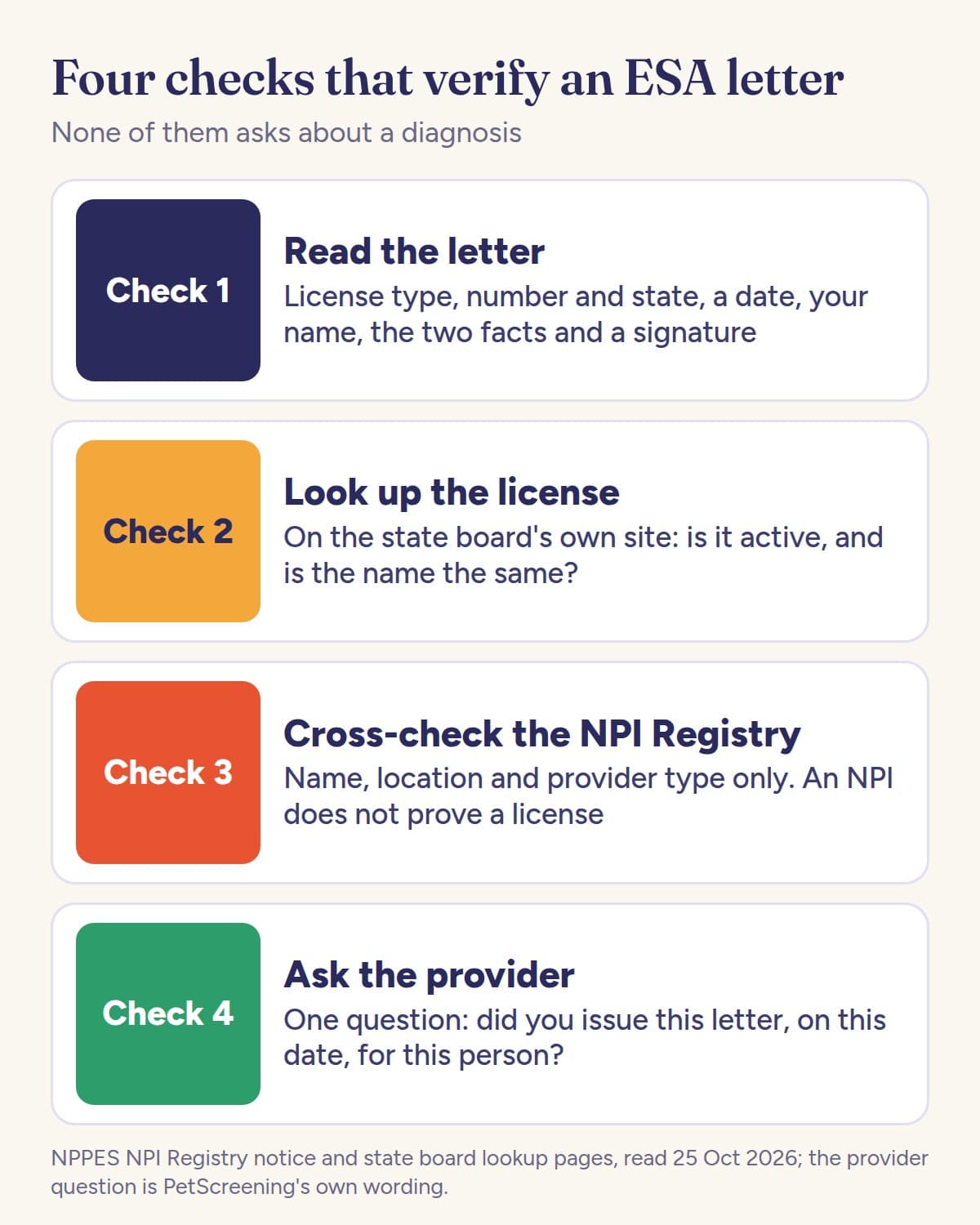
Four checks verify an emotional support animal letter without asking about a diagnosis
- Read the letter for the provider's license type, number and state, a date, the person's name, the two facts a letter has to show, and a signature.
- Look the license up on the licensing board of the state named on the letter, and compare the name, the license type and the status.
- Cross-check the NPI Registry for the provider's name, practice location and provider type. This confirms who they are, not that they are licensed.
- Ask the provider whether they issued the letter. One question, to the provider and no one else.
The first check is reading the letter for six details a reviewer looks for
Who signed it
The provider's name, license type and signature. PetScreening's reviewers check for the provider's name and a signature (PetScreening).
License number and state
California requires an emotional support dog letter to show the license's effective date, number, jurisdiction and type (Cal. H&S § 122318(a)(1)).
Two facts
That the person has a disability, and that the animal helps with it. The letter does not have to name the condition.
A date
PetScreening marks documentation within the last 12 months as "not always required": some properties ask for it and some do not.
The person's name
The letter has to be about the tenant, by name.
A reason for each animal
When a letter covers more than one animal, PetScreening's reviewers look for why each one is needed.
Our free sample ESA letter shows every part annotated, and our ESA letter checker reads a letter against what landlords look for and what state laws write down.
The second check is looking the license up on the state board's own site
The license lookup is the strongest check, because it comes from the agency that issues the license. The Texas Behavioral Health Executive Council describes its own results as "primary source verification" (Texas BHEC). Look the provider up in the state named on the letter, by name or license number, and check that the license type matches the letter and that the status is active.
| State | Where to look | What the record shows |
|---|---|---|
| New Jersey | Division of Consumer Affairs license verification (choose Person Search) | A real-time system with the most current professional license information, intended for verification only. |
| New York | Office of the Professions online verification | Name, profession, license number, location, date of original license and registration status, with summaries of Regents discipline. Pick the right profession first. |
| California | Department of Consumer Affairs License Search | Whether a license is current, expired or subject to discipline such as suspension or revocation, across boards that include Behavioral Sciences, Psychology and the Medical Board. |
| Florida | Department of Health MQA Search Portal | License verification across Florida's health boards, including a category for out-of-state telehealth providers. |
| Texas | Behavioral Health Executive Council | Status, date of first licensure, expiration date, specialty designations and any public disciplinary history, for psychologists, counselors, family therapists and social workers. |
In any other state, search for the licensing board by the provider's profession, such as the state's board of psychology, counseling or social work. Our state-by-state guides name the rules each state adds to the letter, and our guide to who can write an ESA letter covers which licenses count.

The third check is the NPI Registry, which confirms who a provider is but not that they are licensed
The NPI Registry is the federal public search of National Provider Identifiers. You can search by NPI number, by provider name, or by provider type (its taxonomy description), narrowed by state, and a record shows the provider's name, addresses and type. It is a useful second look at whether the name, practice location and kind of provider fit the letter.
What it cannot do is confirm a license. The registry's own page says so: "Issuance of an NPI does not ensure or validate that the Health Care Provider is Licensed or Credentialed" (NPPES NPI Registry). CMS also requires an NPI only of "covered" providers, those who transmit health information electronically in standard HIPAA transactions (CMS FAQ), so a provider with no listing proves nothing by that alone. The state board is where a license is checked.
Give your companion the card
Register your emotional support animal in about 3 minutes. Your Certificate of Registration and wallet ESA Card arrive by email as two print-ready PDFs, backed by a 30-day guarantee.
About 3 minutes · Instant digital delivery
30-day money-back guarantee, no questions asked.The fourth check is to ask the provider whether they issued the letter
PetScreening's description of its own practice is the clearest model. Its reviewers contact health care providers by email, fax or phone, and "our purpose is simply, and only, to confirm the validity of the letter; that is, we ask 'Did you issue the letter dated ___ on behalf of ____?' We do not ask about the Requester's condition, treatment, or any other information related to the specific nature of his/her disability" (PetScreening). It adds that verification "can be as quick as a single phone call/timely email response" and depends on how quickly the provider replies.
OurPetPolicy follows the same pattern and notes that a provider "may require you to complete a Release of Information (ROI) form" before talking to it, so a tenant is told to warn their provider first (help center). Florida's statute draws the same line in law for its housing providers: they may ask for reliable information, but "may not request information that discloses the diagnosis or severity of a person's disability or any medical records relating to the disability" (Fla. Stat. § 760.27(3)(a)). Rules vary by state and building, so check yours with your state's fair housing agency. Our page on HUD's emotional support animal rules covers where the federal guidance stands after HUD withdrew its 2020 notice.
We suggest reaching the provider through the phone number or email on the board's record or the practice's own site, rather than only the contact details printed on the letter. It takes a minute, and it means the person who answers is the one the board knows.
Five results in a lookup are reasons to ask the provider more questions
- No license found, or one that is expired, suspended or revoked. The state boards above show status and discipline, so a mismatch is visible within a minute.
- A name or license type that differs from the letter. A letter signed by a licensed professional counselor should not match a social work license number.
- A license from a different state than the tenant. Florida accepts information from a practitioner licensed only in another state when that person has provided in-person care to the tenant at least once (§ 760.27(2)(b)). Other states set their own rules.
- A letter with no license number at all. California makes the number part of an emotional support dog letter, and a landlord anywhere has nothing to look up without it.
- A letter that came from a questionnaire. OurPetPolicy says documentation "should not be the result of a brief questionnaire and quick call, followed by a fee" (help center). California adds a 30-day client-provider relationship and a clinical evaluation before a practitioner may give emotional support dog documentation (Cal. H&S § 122318).
If your own letter is being verified, check your provider's record first and warn them
- Look up your own provider on the state board and make sure the name and license type match the letter.
- Check the letter shows their license type, number and state, and that it is signed and dated.
- Tell your provider a message is coming and ask whether their office wants a release form signed first.
- Answer quickly if it comes back to you. PetScreening turns a returned profile into Non-responsive after 10 days (how PetScreening reviews a letter).
- Keep your own copy of the letter and of what you submitted, so any mismatch is easy to find.
The other service your landlord may use is covered in our guide to how OurPetPolicy handles an emotional support animal request, and the difference between screening a pet and reviewing an assistance animal is in pet screening for apartments.
No provider of your own? In New Jersey and New York we can book you a live video evaluation with an independent therapist licensed in your state: $120, with $80 back if they can't approve you, and the therapist alone decides on the letter. You can book in New Jersey or book in New York.

Alongside the letter, ESA Card registration gives your animal a wallet card with its photo, a certificate and a number anyone can check at esacard.com/verify, for $39$59$79$99 once, in about three minutes. It is handy for the everyday questions; the letter is what a reviewer reads.
Your pet, in your wallet
The part you actually carry
An ESA letter goes in your lease file. The ESA Card is the everyday one: your animal's photo, a certificate for the wall, and a registration number anyone can check. $39$59$79$99 once, about three minutes.
About 3 minutes · Instant digital delivery
30-day money-back guarantee, no questions asked.