Guides
An ESA Letter for a Dog Documents Your Need, So the Dog Needs No Training or Breed Test
Most emotional support animals are dogs, and the letter for one is about you, not the dog: no training, no breed test. Here is who writes it, what it says, and the two states that add rules for dogs only.

On this page
Dogs are most of what people ask about, and most of what our own customers register: named dog breeds alone are 69.4% of the animals registered with us from August to October 2026, before mixed breeds are counted. The letter, though, is not about the dog. It documents your disability-related need, written by a clinician who evaluated you, so a dog qualifies with no training, no temperament test and no breed list.
A licensed clinician who evaluated you writes the letter, and your dog needs no training for it
Any licensed mental health professional or physician practising within their scope and licensed in the state where you live can write it: therapists and counselors (LPC, LMHC), psychologists, psychiatrists, licensed clinical social workers, marriage and family therapists, psychiatric nurse practitioners, and MDs or DOs. A veterinarian cannot, because the letter is about your health, not the dog's. Our breakdown of who can write an ESA letter covers each credential.
Start with a clinician who already treats you: they know the condition the letter documents, and many write one as part of your care. No current provider? In New Jersey and New York, ESA Card's live video evaluation with a licensed therapist is $120; elsewhere, a legitimate telehealth service with clinicians licensed in your state typically charges $139–$199. Expect a real evaluation before any letter, and read a promise of instant approval as the sign that no clinician is involved.
Ours is a live video call with an independent therapist licensed in your state, refunded in full if they can't approve you, and the therapist alone decides on the letter. You can book in New Jersey or book in New York.

The letter has to name the clinician's license and say what your dog does for you
- Written on the clinician's letterhead, signed and dated.
- Their license type, number and state, which is what a leasing office verifies. California and Arkansas also ask for the license's effective date on a dog letter.
- A statement that you have a condition that substantially limits a major life activity. It should not name your diagnosis, and you do not have to share one.
- A statement that the dog is part of managing that condition: the disability-related need the request rests on.
- Your dog identified, ideally by name. One letter can cover two dogs where the clinician finds you need both.
Our free sample ESA letter shows the format housing providers expect. Bring it to the appointment: many clinicians have never written one, and the format is often the only thing holding them back.
Give your companion the card
Register your emotional support animal in about 3 minutes. Your Certificate of Registration and wallet ESA Card arrive by email as two print-ready PDFs, backed by a 30-day guarantee.
About 3 minutes · Instant digital delivery
30-day money-back guarantee, no questions asked.California and Arkansas set rules for dog letters that no other species gets
Two states wrote their ESA letter laws around emotional support dogs specifically. In California, Health and Safety Code § 122318 bars a clinician from providing documentation for an emotional support dog unless they hold an active license in the state, have had a client-provider relationship with you for at least 30 days, complete a clinical evaluation, and tell you that misrepresenting a dog as a service dog is a misdemeanor. Arkansas copied that list in Ark. Code § 20-14-1003 and added two lines: a clinical evaluation at least once a year, and a yearly review of the need to renew the documentation. Both waive the 30 days for people verified to be homeless.
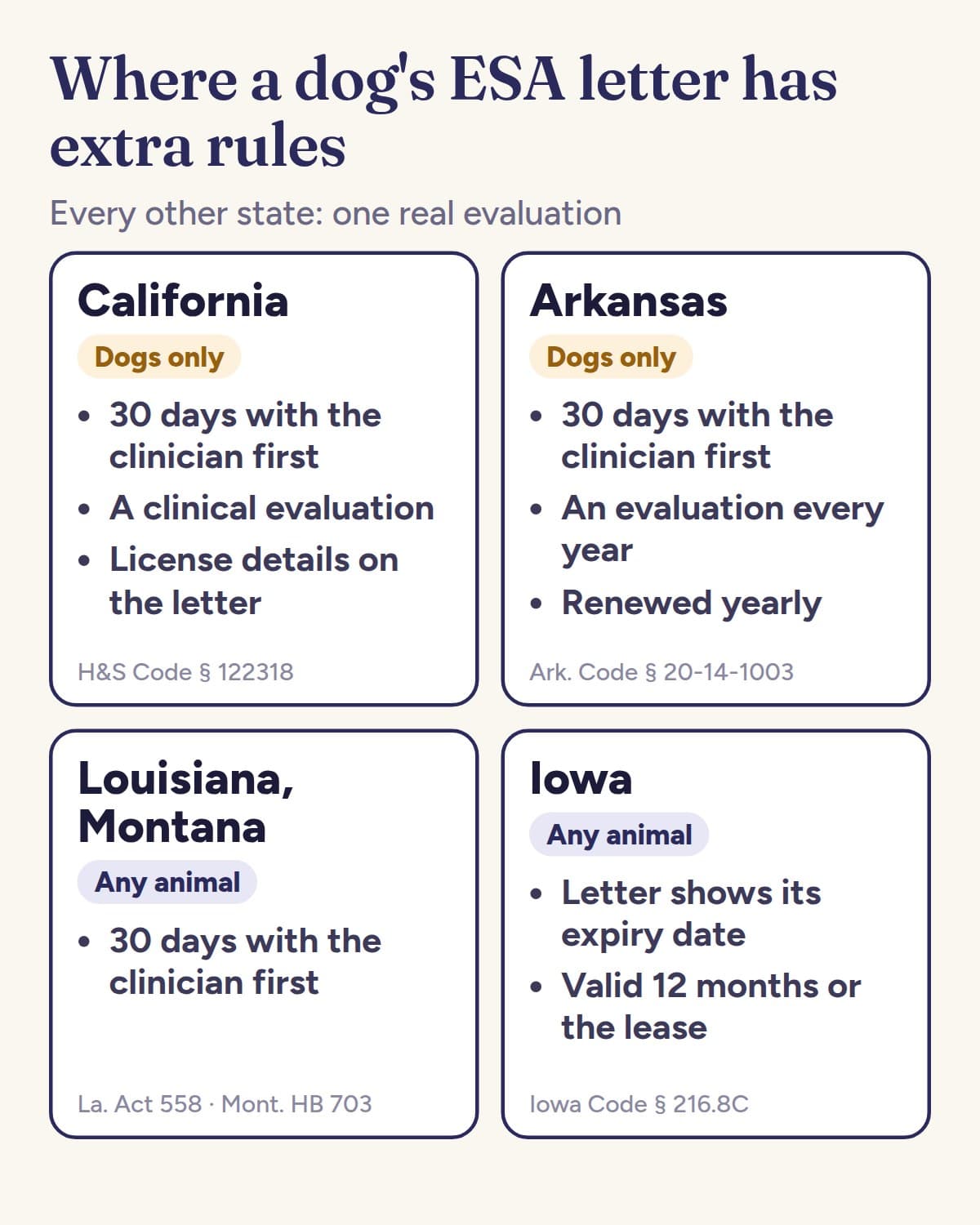
Two more states apply a 30-day relationship rule to every species, dogs included: Louisiana and Montana. Iowa is different again: its written finding must state the date it expires, and it holds for twelve months or the term of the lease, whichever is longer (Iowa Code § 216.8C). Everywhere else, one real evaluation is enough. Our state law table has all fifty, and each state guide has the detail.
HUD's old rule against breed and weight limits was withdrawn in 2025, so your state and building now decide
For years, HUD's 2013 notice told housing providers that "breed, size, and weight limitations may not be applied to an assistance animal", and that a pet deposit could not be charged for one. HUD withdrew that notice and its 2020 successor effective September 17, 2025, and since May 22, 2026 its fair housing office pursues an animal complaint only when the animal is trained to do disability-related work. The Fair Housing Act itself did not change, courts still decide what it requires, and state laws are separate.
So for a pit bull, a German Shepherd or a 90-pound Lab, there is no single federal answer anymore. Ask the building for its animal policy in writing, check your state's rules, and read what HUD changed in 2026 before you sign. A letter from a real clinician is still the document a landlord looks for, and nothing stops a landlord from saying yes.



A dog trained to do tasks is a stronger request than an emotional support dog under HUD's 2026 memo
This is the one place a dog's training matters. HUD's memo borrows the ADA's test: an animal individually trained to do work or perform tasks related to a disability. Comfort and companionship are not tasks under that definition, so an untrained emotional support dog sits outside what HUD's office now pursues, while a trained psychiatric service dog sits inside it. Our guide to the psychiatric service dog and the emotional support dog explains the difference, and the ESA vs service dog page sets them side by side.
Outside housing, an emotional support dog has no public-access rights under the ADA, and since the Department of Transportation's December 2020 rule, U.S. airlines carry it as a pet. An ESA letter is a housing document.
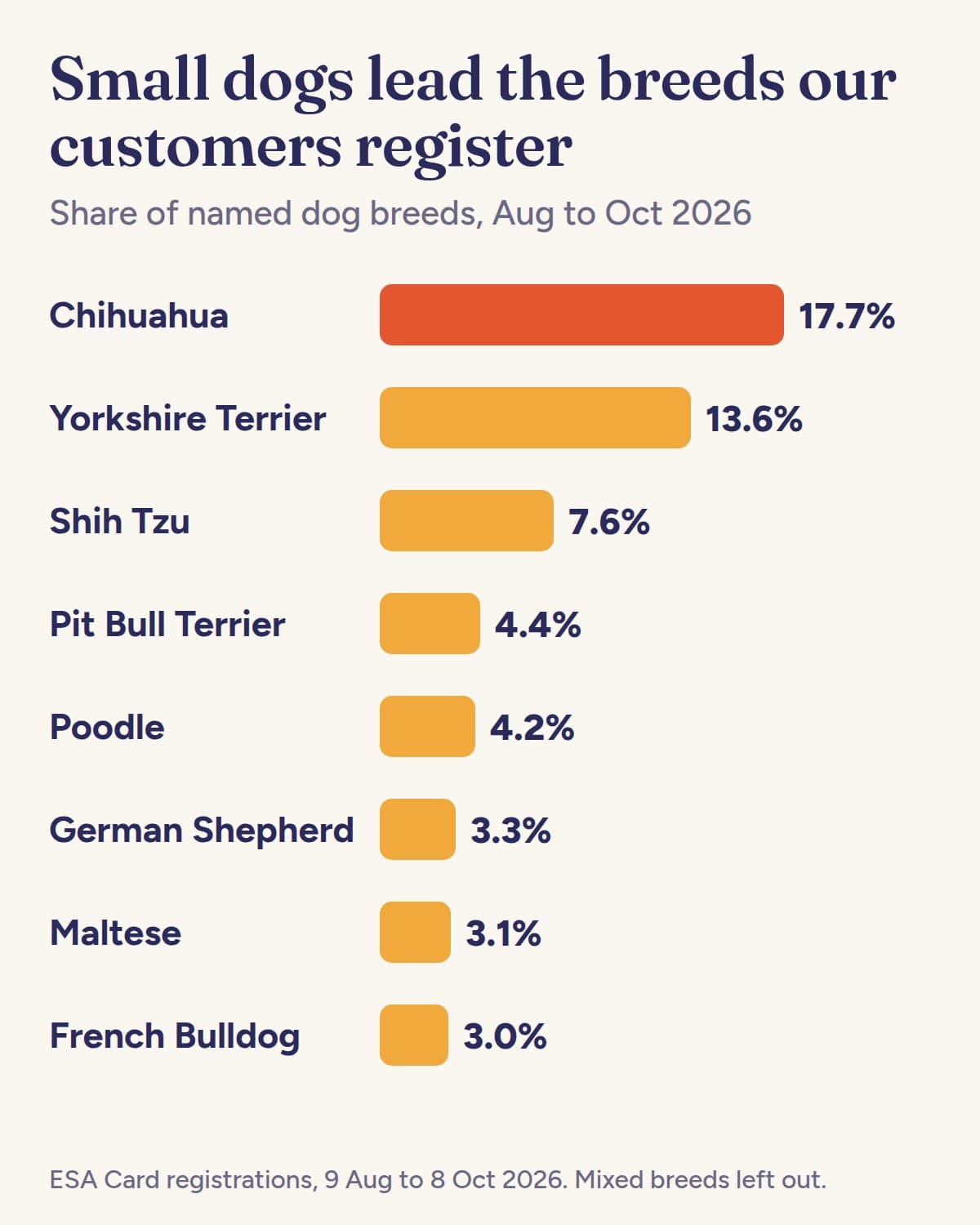
Small dogs lead the breeds our customers register
Among named dog breeds registered with us from August to October 2026, the Chihuahua leads at 17.7%, then the Yorkshire Terrier at 13.6% and the Shih Tzu at 7.6%. Six of the top ten are small dogs, which suits apartments, and the same letter covers a 6-pound Chihuahua and a 70-pound Shepherd. The full table is on our emotional support dog breeds page.
In order: get the letter from a licensed clinician in your state, make sure the license number is on it, and make your request to the landlord in writing. If you are in California or Arkansas and changing clinicians, start a month before you need it. Our guide to making your dog an emotional support dog covers the rest, including the $39$59$79$99 card if you want one.
Your pet, in your wallet
The part you actually carry
An ESA letter goes in your lease file. The ESA Card is the everyday one: your animal's photo, a certificate for the wall, and a registration number anyone can check. $39$59$79$99 once, about three minutes.
About 3 minutes · Instant digital delivery
30-day money-back guarantee, no questions asked.