Housing Rights
You Can Have Two Emotional Support Animals When Each One Has Its Own Reason
No federal law caps how many emotional support animals you can have. What decides it is whether your letter shows a disability-related need for each animal, and how your building and your state weigh a second request.

On this page
The question usually arrives with the second animal: a kitten for the dog, or a partner moving in with their own cat. The number is not what decides it. The reason is. Every animal you ask a housing provider to accept is weighed as its own request, and the letter behind it has to say why you need that animal in particular.
No federal law sets a limit on how many emotional support animals you can have
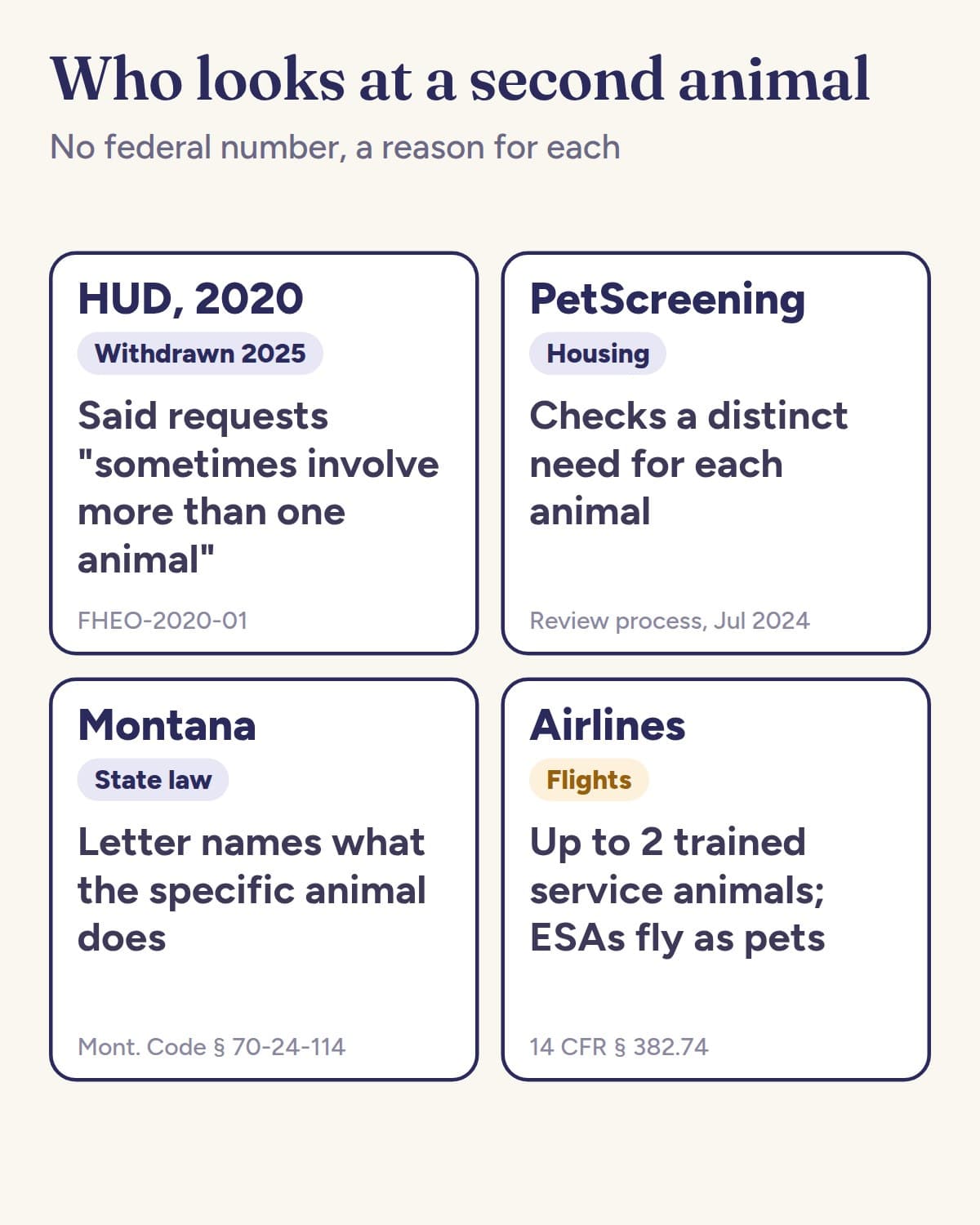
The Fair Housing Act requires housing providers to make reasonable accommodations in their rules and policies when they may be necessary to give a person with a disability an equal opportunity to use and enjoy a home (42 U.S.C. § 3604(f)(3)(B)). Nothing in that text counts animals. HUD's 2020 notice to housing providers said it plainly: "While most requests for reasonable accommodations involve one animal, requests sometimes involve more than one animal", for example when a person has a disability-related need for both, or when two people living together each need their own.
HUD withdrew that notice effective September 17, 2025, and since May 22, 2026 its fair housing office finds cause only where the animal is trained to do disability-related tasks. The Act's text did not change, and courts and state laws still apply it. What HUD changed in 2026 has the timeline.
A letter for two animals has to give a separate reason for each one
One letter can name two animals. What it cannot do is cover them as a pair with one reason. The clinician who evaluated you has to find that each animal eases a symptom of your disability, and say so: the dog that gets you out of the house on bad mornings, the cat that settles you at night. PetScreening, which reviews requests for many landlords, checks for a "distinct disability-related need" whenever a request covers more than one animal, so two animals described with the same sentence is the request most likely to be sent back.
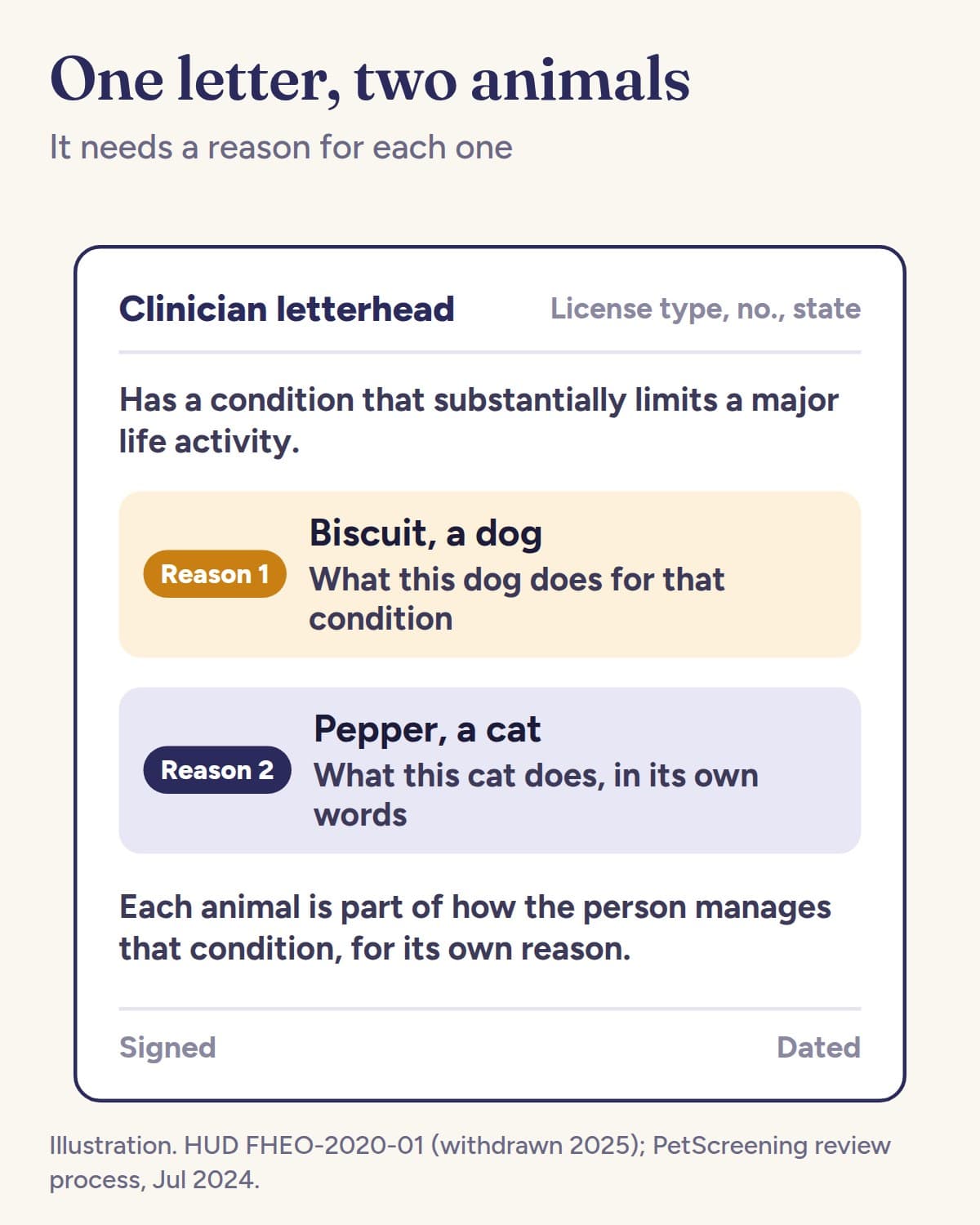
- Both animals by name and species, so nobody has to guess which ones the letter covers.
- What each animal does for you, a sentence each. Montana requires it outright: its law asks the letter to identify the particular support your specific animal provides (Mont. Code Ann. § 70-24-114).
- The clinician's license type, number and state, which is what a leasing office or a screening service verifies.
- A signature and a date. Iowa findings, Arkansas dog letters and PetScreening profiles all run on one-year clocks; our ESA letter renewal guide has the details.
Our free sample ESA letter shows the format. If the second animal arrives after your letter was written, ask the clinician who wrote it for an updated letter that names both.
Give your companion the card
Register your emotional support animal in about 3 minutes. Your Certificate of Registration and wallet ESA Card arrive by email as two print-ready PDFs, backed by a 30-day guarantee.
About 3 minutes · Instant digital delivery
30-day money-back guarantee, no questions asked.The building weighs a second animal on the facts of that home
A reasonable accommodation is judged request by request, and a second animal adds facts to weigh: the size of the unit, how the animals behave, and whether either poses a direct threat to others. Screening services work the same way. PetScreening's reviewers look at the disability, the disability-related need, the date of the documentation and, for more than one animal, a distinct need for each, before they contact your provider. Our PetScreening guide walks through each step.
Whether a second animal is reasonable depends on your state, your building and the animals themselves. Ask for the animal policy in writing, make the request for both animals in writing, and check your state's rules in our ESA laws by state table.



Two people in one home can each have their own emotional support animal
HUD's 2020 notice named this case directly: two people living together who each have a disability-related need for a separate animal. That makes two requests and two letters, each from that person's own clinician, and each letter names only that person's animal.
Flights follow different rules, because airlines carry emotional support animals as pets
Housing rules do not carry over to the plane. Since the Department of Transportation's December 2020 rule, U.S. airlines may carry an emotional support animal as a pet, under their own pet limits and fees. For trained service animals the rule sets a cap: an airline is "not required to accept more than two service animals for a single passenger with a disability" (14 CFR § 382.74).
A clinician who already treats you is the quickest route to a letter that names both animals
They know the condition the letter documents and can describe what each animal does for you. No current provider? In New Jersey and New York, ESA Card's live video evaluation with a licensed therapist is $120; elsewhere, a legitimate telehealth service with clinicians licensed in your state typically charges $139–$199.
Ours is a live video call with an independent therapist licensed in your state, refunded in full if they can't approve you, and the therapist alone decides on the letter and what it covers. You can book in New Jersey or book in New York.

In order: get a letter from a licensed clinician in your state that names every animal and gives a reason for each, make the request to your landlord in writing for all of them, and keep the letter current.
Your pet, in your wallet
The part you actually carry
An ESA letter goes in your lease file. The ESA Card is the everyday one: your animal's photo, a certificate for the wall, and a registration number anyone can check. $39$59$79$99 once, about three minutes.
About 3 minutes · Instant digital delivery
30-day money-back guarantee, no questions asked.