Housing Rights
To Give Your Landlord an ESA Letter, Send a Written Request With the Letter Attached
Send your landlord one written request with the letter attached and keep every reply in the thread. Here are the five steps, an email you can copy, what a dog in a no-pets building needs, and what to do if the answer is no.

On this page
To give your landlord an ESA letter for an apartment, email a written reasonable-accommodation request with the letter attached, and keep the whole exchange in that one written thread. Name your animal, say you are asking for an exception to the building's pet policy because of a disability-related need, and ask for the answer in writing. Below are five steps, an email you can copy, and what to do in a no-pets building or if your landlord says no.
Five steps get your ESA letter to your landlord in a way that holds up
- Get the letter first. It comes from a licensed mental health professional or physician, licensed in your state, who has evaluated you. Ask a therapist, psychiatrist or doctor who already treats you, since many write one as part of your care, and hand them our free sample ESA letter. More on who can write an ESA letter.
- Check the letter before you send it. It should be on the provider's letterhead, signed and dated, with their license type, number and state, and say that you have a disability and that the animal helps with it. It does not need to name your diagnosis.
- Write the request. Email works. Say you are requesting a reasonable accommodation for an assistance animal under the Fair Housing Act, name the animal and date it. You can ask before or after moving in, and before or after getting the animal.
- Attach the letter and send it from your own email. Attach it up front, or when they ask for supporting documentation. Email gives the request a date.
- Keep everything in the thread and ask for a written answer. A dated email chain is worth more three months later than a friendly phone call nobody wrote down. Silence or indefinite stalling can itself amount to an unlawful denial of the accommodation.
Many landlords now take the request through a screening portal instead of email. If yours sends you a PetScreening link, the letter is still the document that decides it: our guide to how PetScreening reviews an ESA letter shows what its reviewers check and how they contact your provider. Our guide to an ESA letter for housing covers what a housing-valid letter contains in full.
A short email with the letter attached is all the request needs
Copy this, swap in your own details and send it from your own email address. Oscar, a Golden Retriever, is the sample dog.
Subject: Reasonable accommodation request for my emotional support animal, [Unit]
Hello [Landlord or property manager name],
I live at [Address], [Unit]. I have a disability, and I am requesting a reasonable accommodation under the Fair Housing Act: an exception to the building's pet policy so that my emotional support animal, Oscar, a Golden Retriever, can live with me. A letter from my licensed provider documenting my disability-related need for Oscar is attached.
Please reply in writing and tell me if you need anything else from me. Thank you, [Your name], [Phone number], [Date]
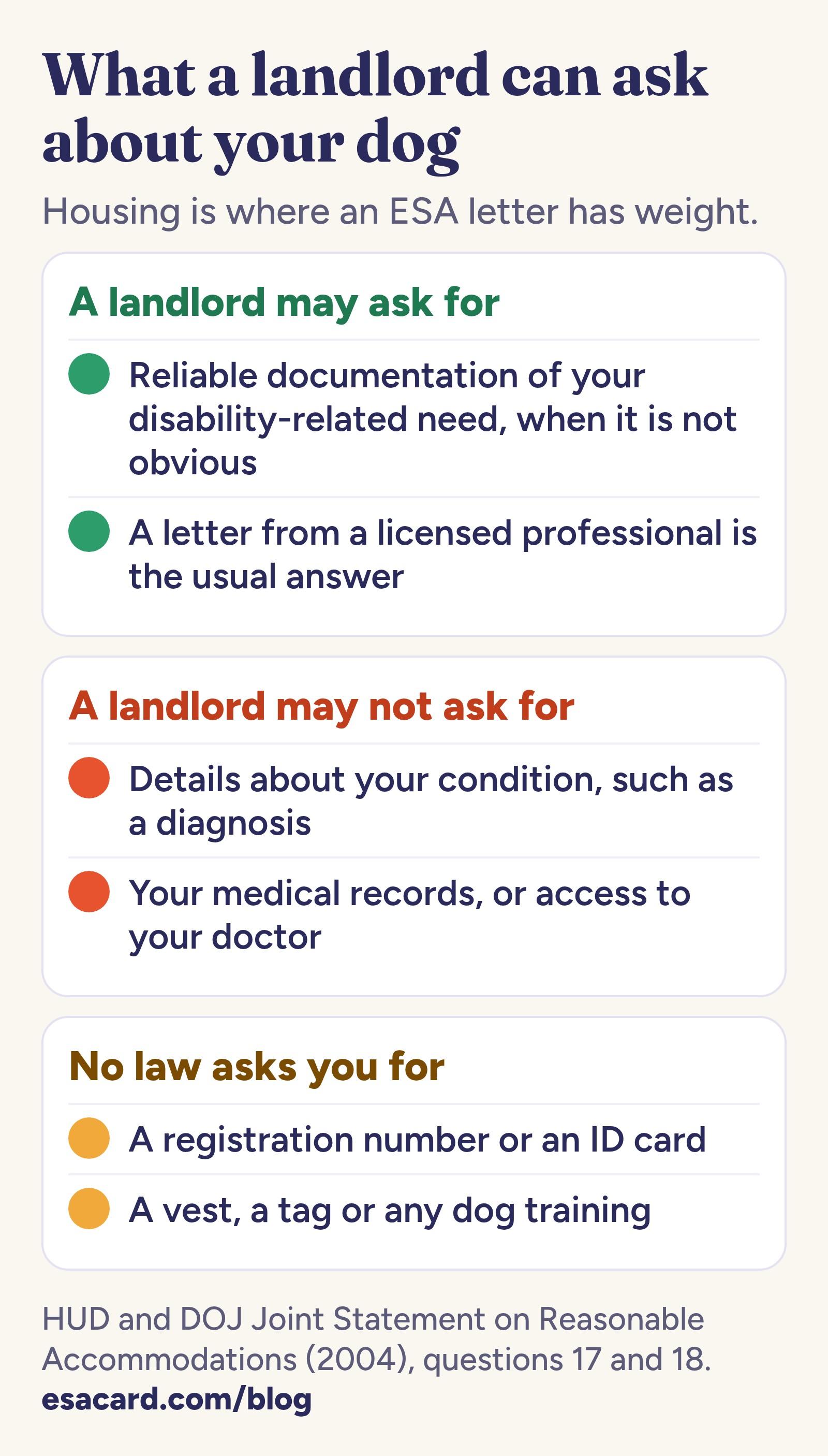
Leave your diagnosis out. The letter shows that you have a disability and that the animal helps with it, not which condition you have, and a landlord may not ask for your diagnosis or medical records.
The letter is the one document that proves your animal is an emotional support animal
The only document you need is an ESA letter from a licensed mental health professional who has evaluated you, handed over with your written request. Under the Fair Housing Act it is the one document a housing provider is obligated to take seriously. A housing-valid letter has four things:
- A licensed professional in your state wrote it, after a real treatment or evaluation relationship with you.
- It is on letterhead, with the provider's license type, license number, contact details, signature and date. The license number is what a leasing office verifies.
- It states two facts: you have a condition that qualifies as a disability, and the animal provides support that alleviates at least one symptom of it.
- It is recent. Federal law sets no expiry, but providers customarily expect a letter dated within the past 12 months.
You do not need a registration, an ID card, a vest or a diagnosis. There is no government registry for emotional support animals, so no landlord can require a number from one, and ESAs have no housing obligation to be marked with a vest, patch or tag. A landlord may check that the letter is genuine, for example by confirming the provider's license, but may not ask for your diagnosis, require a specific form or notarization, or insist on training for the animal. A card or certificate shown alone can lawfully be declined, which is why the letter leads.
Give your companion the card
Register your emotional support animal in about 3 minutes. Your Certificate of Registration and digital ESA Card arrive by email as two print-ready PDFs, backed by a 30-day guarantee.
About 3 minutes · Instant digital delivery
30-day money-back guarantee, no questions asked.A letter for a dog needs no training, and four states add a 30-day wait
To get an ESA letter for a dog in a no-pets apartment, have a licensed mental health professional or physician in your state evaluate you and write it. The letter documents your need, not the dog's skills, so your dog needs no training, certification or breed test, and a veterinarian cannot write it because the letter is about your health.
Start with a clinician who already treats you, and bring them our free sample ESA letter: many clinicians have never written one, and the format is often the only thing holding them back. Our guide to an ESA letter for a dog covers the rest.
No provider of your own? In Florida, New Jersey, New York and Ohio we can book you a live video evaluation with an independent therapist licensed in your state: $120, with $80 back if they can't approve you, and the therapist alone decides on the letter. You can book in Florida, book in New Jersey, book in New York or book in Ohio.

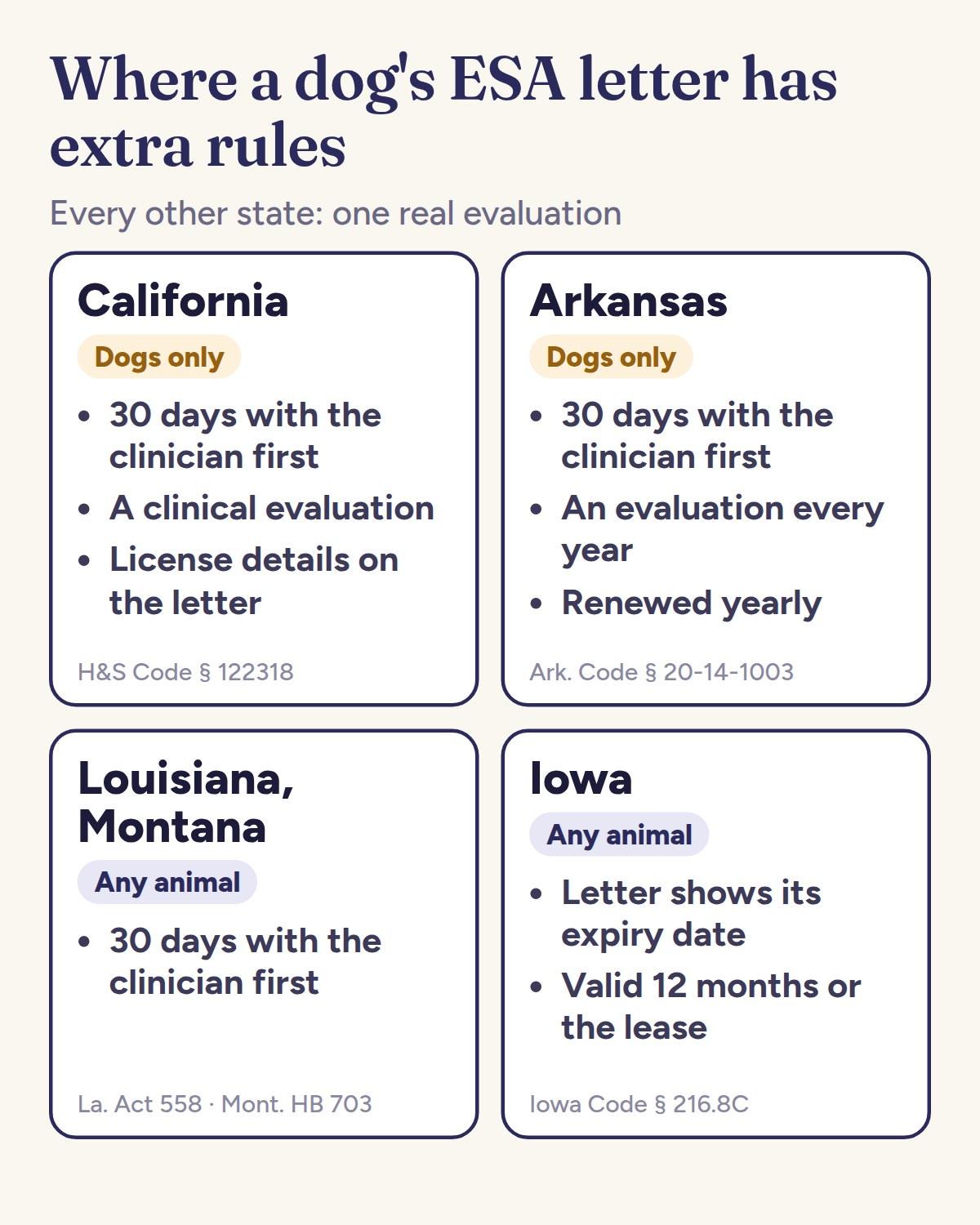
Four states add a timing rule. In California and Arkansas, a clinician may not document an emotional support dog until they have had a client-provider relationship with you for at least 30 days, and Arkansas also wants a yearly evaluation. Louisiana and Montana require the 30 days for any animal. Everywhere else, one real evaluation is enough. Our state law table has all fifty.
Most no-pets buildings still have to consider your dog as an exception to their policy
A no-pet policy is not a lawful reason to refuse an emotional support animal: your request asks for an exception to it, and a housing provider covered by the Fair Housing Act has to consider that request. Rules vary by state and building, so these are the points to know before you send it:
- The policy stays in force for everyone else. A roommate's ordinary pet is still barred, and leash, waste and noise rules apply to your dog like any other animal in the building.
- Breed and weight limits. Many landlords set aside breed and weight limits for an ESA with a clinician's letter; rules vary by state and building, so ask yours. HUD's old notice said such limits could not be applied to an assistance animal, but HUD withdrew it effective September 17, 2025, so there is no single federal answer. Ask the building for its animal policy in writing.
- Deposits, pet rent and fees. Many landlords waive them for an ESA with a clinician's letter. HUD and the Justice Department's position is that a landlord cannot require a pet deposit, pet fee or pet rent as a condition of keeping an assistance animal, only repayment for damage the animal causes, and some states bar these charges in their own law. Our guide to pet deposits, pet rent and fees for an ESA has the cases and the dollar amounts, and our ranking of the best states for renters with an ESA lists which states bar them.
- A few homes are exempt. Owner-occupied buildings with four or fewer units and single-family homes rented without a broker fall outside the Fair Housing Act, though some state laws reach them anyway.



If your landlord stays silent or says no, ask for the reason in writing
If your landlord ignores your request or refuses it, ask for the answer and the legal exception they rely on in writing, point them to the license number on the letter, and go to your state's fair-housing agency if they cannot name one.
- Ask for the denial in writing, along with the exception they claim. "Policy" is not a legal basis. The lawful grounds are narrow: an exempt building, a direct threat or real damage from your own animal, an undue burden, or documentation that is not credible. Our guide to when a landlord can deny an emotional support animal lists them.
- Invite verification. Give the leasing office your clinician's name and license number and let them check it. Many refusals dissolve once the office confirms the clinician is real and licensed. Our guide to how to verify an ESA letter shows the checks.
- File with your state fair-housing agency. Most states run one, filing costs nothing, and many enforce state laws broader than the Fair Housing Act.
- Consider a private lawsuit. The Fair Housing Act lets you sue in state or federal court within two years of the denial. You can still file with HUD within one year, but since HUD's May 2026 enforcement memo its fair-housing office no longer pursues complaints over untrained emotional support animals, so do not make that your only move. Our page on HUD's emotional support animal rules has the details.
Alongside the letter, ESA Card registration gives your animal a digital ESA Card with its photo, a certificate and a number anyone can check at esacard.com/verify, for $39$59$79$99 once, in about three minutes. It is handy for everyday questions and it is optional: the letter is what your landlord reads.
In order: get the letter from a licensed clinician in your state, send one written request with the letter attached, keep every reply in the thread, and ask for any refusal in writing. Our guides to ESA letters for housing and the Fair Housing Act and emotional support animals cover the law behind each step.
Give your companion the card
Register your emotional support animal in about 3 minutes. Your Certificate of Registration and digital ESA Card arrive by email as two print-ready PDFs, backed by a 30-day guarantee.
About 3 minutes · Instant digital delivery
30-day money-back guarantee, no questions asked.Keep reading