Housing Rights
PetScreening Checks an ESA Letter by Contacting the Provider Who Signed It
If your landlord sent you a PetScreening link, your ESA letter is about to be read by a review team that checks five things and then contacts your provider. Here is that process, step by step, from PetScreening's own documents.
On this page
If your landlord or property manager sent you a link to PetScreening, your emotional support animal request is going through a screening service that, by its own count, more than 28,000 property management firms and communities use, and that has completed over a million assistance animal reviews. ESA Card has no connection to PetScreening. Everything below comes from PetScreening's own pages and its written review process, linked where it appears and read on October 19, 2026.
PetScreening reviews an assistance animal request for free, on a different track from pets
PetScreening runs two separate processes. A household pet gets a profile with an annual fee and a FIDO Score, a 1-to-5 paw rating of "the household-related risk of a specific pet and its owner", built from breed, pictures, weight, vaccination records and behavior (PetScreening). An assistance animal request goes instead to its in-house Assistance Animal Review Team, which PetScreening's legal team manages (PetScreening).
Free to submit
"There is no charge for assistance animal profiles", and PetScreening says you will never be charged to renew one (residents FAQ).
Two request types
Emotional support animal, which is reviewed on a letter, or service animal, a dog trained to do work or tasks, which needs no letter.
Good for one year
Every profile expires one year after it is activated, so the request is made again each year, still at no charge.
No diagnosis asked
"PetScreening never requires disclosure of a specific diagnosis." The letter shows that you have a disability, not which one.
A reviewer checks five things on an emotional support animal letter
PetScreening's written review process lists what a reviewer looks for in the documents attached to a support animal profile, after checking the account, the animal's name, pictures and vaccines, and your affirmations:
- A disability. The letter has to establish that you have one. It does not have to name it.
- A disability-related need for the animal. The letter has to connect the animal to that disability: it helps with its effects.
- A recent date. Documentation issued within the last 12 months, which PetScreening marks "not always required": some properties ask for it and some do not.
- A distinct need for each animal, when you ask for more than one. A letter covering two animals has to say why each one is needed.
- Your name, and the provider's name and signature. The letter has to be about you and signed by the person who wrote it.
Service animals take a different route. The reviewer asks the two questions the law allows, whether the animal is required because of a disability and what task it has been trained to perform, and no letter is involved.
When the letter passes, PetScreening contacts the provider who signed it
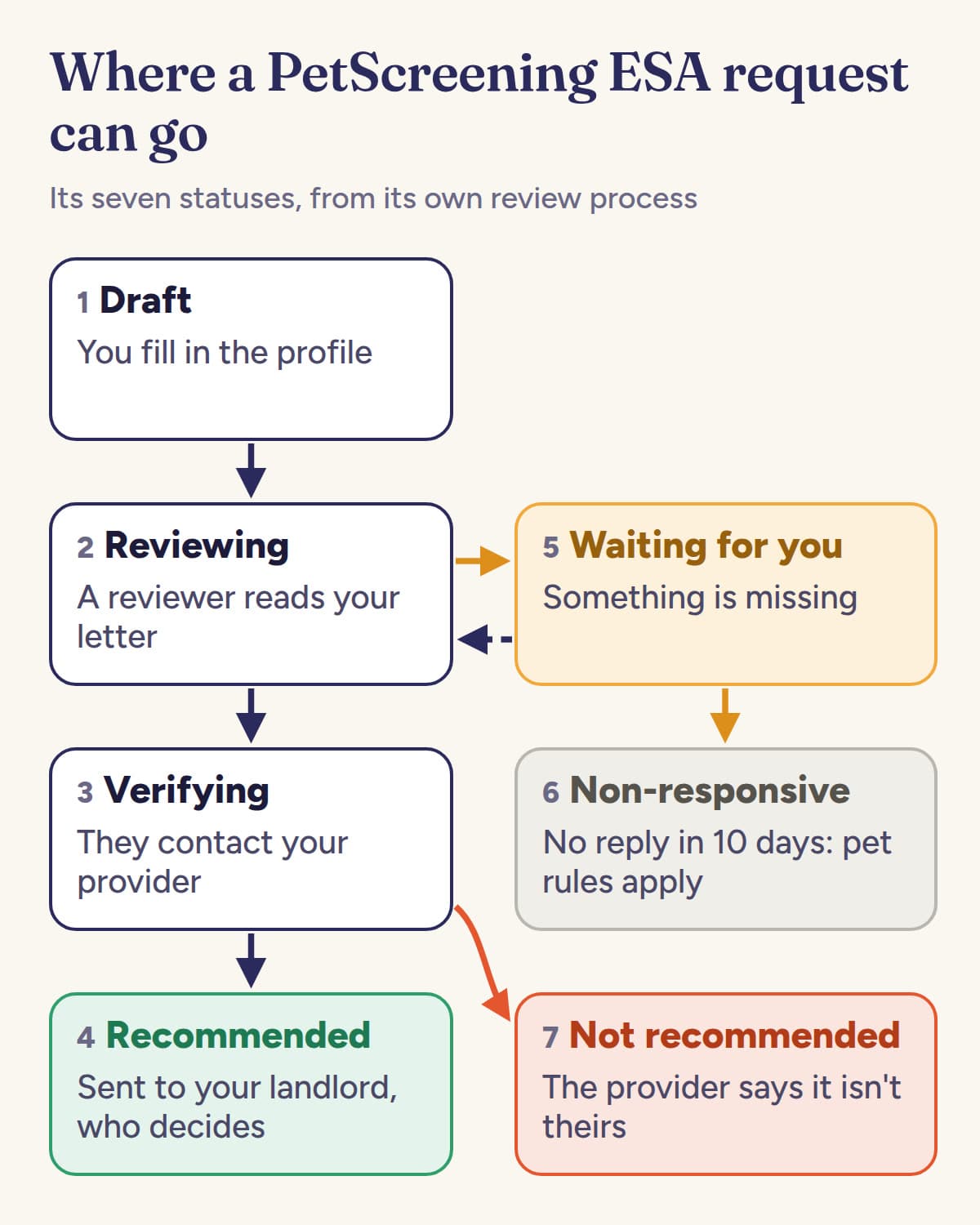
A letter that meets those checks moves to Verifying. PetScreening says its review team "contacts every health care provider to affirm the documentation submitted is authentic", and its process document lists three ways it does: an email to the provider with a direct link to your profile, a fax, or a phone call from its Verification team. When the provider confirms the letter, the profile becomes Recommended.
Two things can go wrong at this step. If the provider's office never answers, or says you have steps to complete first, the profile can be sent back to you. If the provider says they did not write the letter, PetScreening asks for that in writing and then marks the request Not Recommended, the status it keeps for documents it confirms are falsified and for an animal that poses a direct threat to others.
That is why the provider's contact details matter as much as the wording. A letter whose signer cannot be reached stalls at Verifying, however well it is written.
A request is treated as abandoned after 10 days without a reply
When something is missing, the profile comes back to you as Waiting for Animal Owner, with a note saying what is needed, and PetScreening sends reminders on the 6th and the 10th day. After 10 days with no resubmission the profile turns Non-responsive, PetScreening stops following up, and the request is "considered abandoned, subjecting the resident and their animal to the community's usual pet policies and fees." Your animal is then handled as a pet, with whatever pet rent and fees your building charges.
So watch your email while the review runs. You cannot edit a profile while it is being reviewed, but you can once it is returned to you, and a resubmitted profile goes back into review.

Give your companion the card
Register your emotional support animal in about 3 minutes. Your Certificate of Registration and wallet ESA Card arrive by email as two print-ready PDFs, backed by a 30-day guarantee.
About 3 minutes · Instant digital delivery
30-day money-back guarantee, no questions asked.PetScreening makes a recommendation, and your landlord makes the decision
PetScreening's residents page says it plainly: "Our role is to provide a recommendation; the community retains full authority to approve or deny requests." Properties can add their own requirements on top of the review, such as a letter dated within the last 12 months, and some property policy pages hosted on PetScreening say they do not accept online certificates, registrations or ID cards on their own.
PetScreening says it reviews requests against the Fair Housing Act and HUD's guidelines. HUD withdrew its 2013 and 2020 assistance animal notices, effective September 17, 2025, and since May 22, 2026 its fair housing office pursues an animal complaint only when the animal is trained to do disability-related work or tasks. The Fair Housing Act itself, your right to go to court and state laws did not change. Our page on HUD's emotional support animal rules has the documents.
Letters get sent back for missing pieces, and a registration is never what gets reviewed
No way to reach the provider
The reviewer has to be able to contact their office. A letter with no license number, address or phone number gives them nothing to check.
No signature, or no name
A typed name with no signature, or a letter that never names you, fails the fifth check.
An old date
Where your property asks for documentation from the last 12 months, an older letter is sent back.
Two animals, one reason
A letter covering more than one animal has to say why each one is needed.
A certificate instead of a letter
A registration, a certificate or an ID card, ours included, is not the documentation PetScreening reviews. The letter is.
No reply in 10 days
A returned profile left alone for 10 days becomes Non-responsive, and the animal is handled as a pet.
A letter that passes comes from a licensed provider who evaluated you and can be reached
The letter that clears every step above is an ordinary one: on the provider's letterhead, with their license type, number and state, your name, the two facts about disability and need, a date and a real signature. Our free sample ESA letter shows each of those parts. The quickest route is a therapist, psychiatrist or doctor who already treats you. They know you, they can confirm the letter when PetScreening contacts them, and many write one as part of your care. Our guide to who can write an ESA letter covers which licenses count.
No provider of your own? In New Jersey and New York we can book you a live video evaluation with an independent therapist licensed in your state: $120, refunded in full if they can't approve you, and the therapist alone decides on the letter. You can book in New Jersey or book in New York.

Alongside the letter, ESA Card registration gives your animal a wallet card with its photo, a certificate and a number anyone can check at esacard.com/verify, for $39$59$79$99 once, in about three minutes. It is handy for the everyday questions; the letter is what a PetScreening reviewer reads.
Your pet, in your wallet
The part you actually carry
An ESA letter goes in your lease file. The ESA Card is the everyday one: your animal's photo, a certificate for the wall, and a registration number anyone can check. $39$59$79$99 once, about three minutes.
About 3 minutes · Instant digital delivery
30-day money-back guarantee, no questions asked.