Housing Rights
Pet Screening for Apartments Profiles Your Pet and Reviews Your ESA Letter
If your apartment sent you a pet screening link, it is either a pet profile with photos, vaccine records and sometimes a fee, or an emotional support animal request reviewed on your provider's letter. How each one works, from the services' own pages.

On this page
If your apartment's application asks you to complete a pet screening, you have been sent to a third-party service such as PetScreening or OurPetPolicy, and what you do next depends on the animal. A pet gets a profile with photos and vaccine records. An emotional support animal gets a separate request, reviewed on a letter from your provider. This guide covers both, from what the two services publish themselves, read on October 25, 2026. ESA Card has no connection to either service.
Pet screening is a profile of your animal that an apartment asks for before the animal moves in
PetScreening describes itself as "a third-party service utilized by property managers/landlords/housing providers to screen non-pet owners, pet owners, household pets, and Assistance Animals" (PetScreening FAQ), and says more than 28,000 communities use it (PetScreening). OurPetPolicy calls itself a solution "to manage residents with pets, emotional support animals, service animals, and more" (OurPetPolicy). Your property picks the service, and the link usually comes from your property manager: OurPetPolicy says you will get an email from it, or your property manager will hand out a sign-up sheet or a link (help center).
The profile you create depends on whether you have no animal, a pet or an assistance animal
No animal
PetScreening still asks every resident for a profile, and a no-pet profile is $0 and "can be completed in 5 minutes or less" (PetScreening FAQ). At OurPetPolicy you fill out a form saying you have no animals.
A pet
A household pet profile with photos, vaccine records and a few details. It has a fee at PetScreening, and the property can approve it or not on its own policy.
An emotional support animal
A separate request, reviewed on a letter from your provider. It is $0 at PetScreening. Our guides to PetScreening and OurPetPolicy cover each service.
A service animal
On PetScreening it is also an assistance animal profile at $0, and no letter is involved. Our PetScreening guide covers the two questions its reviewer asks.
A pet profile asks for photos, vaccine records and a few details about the animal
Photos
PetScreening tells you to gather photos of your pet, vaccination records and, if they apply, microchip information (PetScreening FAQ). OurPetPolicy asks for a picture of your animal (resident FAQ).
Vaccine records
OurPetPolicy asks for a current vaccination record, "a current rabies vaccination is most common". PetScreening takes the shot type, dates and an uploaded record, in JPG, JPEG, GIF, PNG or PDF files up to 25 MB (PetScreening).
Basic details
OurPetPolicy lists species, breed, birthday, color, weight, gender, spayed or neutered, house training and aggression history (help center).
A signed addendum
OurPetPolicy has you sign the property's animal addendum, which says you agree to follow its animal policies.
Other records
Some properties also ask for a city license, proof of spay or neuter, or other vet records. OurPetPolicy tracks what each property needs and tells you what is missing.
A yearly renewal
A PetScreening profile is active for one year from activation, and it emails you expiry notices starting 30 days out.
A PetScreening pet profile costs $30 by card or $25 by ACH, and an assistance animal profile costs nothing
$30
for a household pet profile, new or renewed, paid by card
$25
for the same profile paid by ACH
$0
for an assistance animal profile or a no-pet profile
PetScreening says the fee is an annual one for household pet profiles, "helps cover the cost of securely processing and managing your pet's information", and that there is "no charge for assistance animal profiles or no-pet profiles" (PetScreening). Renewing early is cheaper by $5, so $25 by card or $20 by ACH, and a household pet profile can be renewed up to 90 days before it expires (PetScreening). OurPetPolicy publishes no resident price: its sign-up guide says only "Some properties require payment for this application", and its form for property managers asks whether the company or the tenant will pay.
A FIDO Score rates a pet from 0 to 5 paws, and the apartment decides what to do with it
PetScreening calls the FIDO Score "a housing-related risk indicator for each pet". It weighs breed, sex, age, weight, behavior and the owner's care, and a 5-paw score means potentially lower risk while a 1-paw score means potentially higher risk. A 0-paw score means the pet hits a limit in the property's own policy on weight, breed, age, spay or neuter status or reported bites (PetScreening).
Two details are worth knowing. PetScreening says "we do not approve or deny household pet profiles": it shares the score with the property, and what to do with it, and whether to show it to you, are the property's decisions. It also says it can score a pet low on breed, weight or age even where the property has no limit, and that this "doesn't mean you have to deny the pet".
You can raise a score with the parts that are in your hands: exact vaccination details, an uploaded vaccination record, spaying or neutering, and photos of the pet. Breed, age and weight are not in your control.
Give your companion the card
Register your emotional support animal in about 3 minutes. Your Certificate of Registration and wallet ESA Card arrive by email as two print-ready PDFs, backed by a 30-day guarantee.
About 3 minutes · Instant digital delivery
30-day money-back guarantee, no questions asked.The two services judge a pet differently, and the apartment makes the final call
| For a pet | PetScreening | OurPetPolicy |
|---|---|---|
| What you submit | A pet profile with photos, vaccine records and details about the animal. | A pet application with a photo, details, vet records and a signed animal addendum. |
| What it costs you | $30 by card or $25 by ACH, renewed yearly. | No resident price published. Some properties require a payment. |
| How it is judged | A FIDO Score of 0 to 5 paws, shared with the property. | Checked for complete documents that match the property's pet policy. |
| How long it takes | Active as soon as it is submitted and shared with the property. | Verified within 1 to 2 business days when the documents are complete (help center). |
| Who decides | The property. PetScreening does not approve or deny a pet profile. | The property manager gives final approval after the verification. |
Some properties also ask a resident to finish responsible animal ownership training before an OurPetPolicy application counts as complete (help center). What a pet costs beyond the profile is your building's call: OurPetPolicy's own blog says a pet is "subject to typical property owners policies, including pet fees, deposits, and restrictions" (OurPetPolicy).
An emotional support animal takes the other route, and the wrong profile can cost a fee
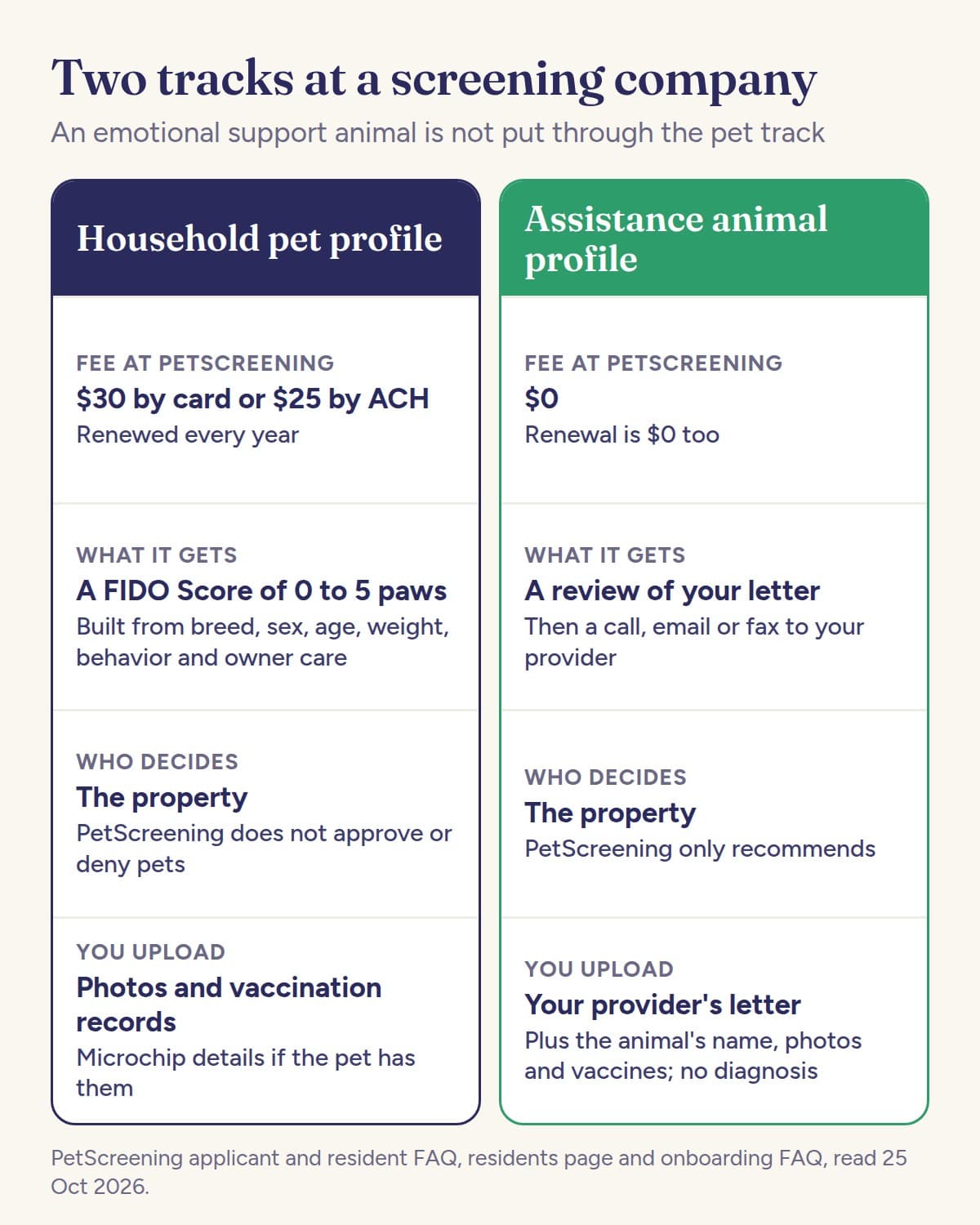
An emotional support animal request is not a pet profile. At PetScreening it goes to the Assistance Animal Review Team, whose standard review time is "2-5 business days from the date of submission", and which makes a recommendation that the property can follow or not (PetScreening). At OurPetPolicy the service contacts your provider and then decides the request itself. Our guides explain each one: how PetScreening verifies an emotional support animal letter and how OurPetPolicy handles an emotional support animal request.
PetScreening tells property managers that when a resident says they are being charged for an assistance animal, it is likely they created a household pet profile by mistake. The fix it gives is to convert the profile (PetScreening):
- Open the pet profile in your PetScreening account and click Edit.
- Make sure it is shared with your property management company.
- Click the small pencil under the animal's name and check the box that says you are making a reasonable accommodation request.
- Upload your provider's letter under Animal Details, then submit the profile for review.
If you already paid for the household pet profile, PetScreening says that once the request is reviewed and shows Recommended, you can email its support team and it is "more than happy to refund the household pet profile charge" (PetScreening). At OurPetPolicy you say what kind of animal you have as you add it, choosing pet, service animal or emotional support animal (help center).
What you pay for an emotional support animal depends on your state and your building
Many landlords waive pet fees for an emotional support animal with a clinician's letter; rules vary by state and building, so ask yours. What the services say is narrower: PetScreening says a profile returned to you and left for 10 days is "considered abandoned, subjecting the resident and their animal to the community's usual pet policies and fees." Our guides to a landlord denying an emotional support animal and to the letter for housing cover what the letter does, and our state guides cover the rules each state adds.
A few habits keep a screening profile from stalling
- Use the link your property sent. A profile made without it can still be found, but the property has to request access and you have to grant it (PetScreening).
- Activate the profile. A draft is not shared with your housing provider until you activate it, and each yearly renewal has to be updated and activated to be shared again (PetScreening FAQ).
- Pick the right profile type before you pay: a pet profile for a pet, an assistance animal profile for an emotional support animal.
- Upload a supported file. PetScreening takes JPG, JPEG, GIF, PNG and PDF files up to 25 MB each.
- Answer within 10 days if PetScreening returns an assistance animal profile to you, or it turns Non-responsive.
- Keep the profile when you move. PetScreening says an active pet profile is transferable between housing providers.
If your provider's letter is the part that is missing, our free sample ESA letter shows each piece a reviewer reads, and our guide to how a letter is verified shows the checks it goes through.
No provider of your own? In New Jersey and New York we can book you a live video evaluation with an independent therapist licensed in your state: $120, with $80 back if they can't approve you, and the therapist alone decides on the letter. You can book in New Jersey or book in New York.

Alongside the letter, ESA Card registration gives your animal a wallet card with its photo, a certificate and a number anyone can check at esacard.com/verify, for $39$59$79$99 once, in about three minutes. It is handy for the everyday questions; the letter is what a screening reviewer reads.
Your pet, in your wallet
The part you actually carry
An ESA letter goes in your lease file. The ESA Card is the everyday one: your animal's photo, a certificate for the wall, and a registration number anyone can check. $39$59$79$99 once, about three minutes.
About 3 minutes · Instant digital delivery
30-day money-back guarantee, no questions asked.