Housing Rights
RPM Living Says Its Pet-Friendly Communities Have No Breed or Age Restrictions
What RPM Living's own residents page and move-in checklist say about pets, breed limits and charges, what they leave out about assistance animals, and what HUD's documents add.

On this page
RPM Living says its pet-friendly communities have no breed or age restrictions, and its move-in checklist says residents moving in with a pet need to have paid the pet deposit and pet fee first. The two pages we read give no dollar amounts and say nothing on assistance animals. ESA Card has no connection to RPM Living: its registration is the ID card you carry beside your provider's letter.
RPM Living has no single pet policy page that we found. We read two of its pages: the residents page and a post, the move-in checklist, dated "Mar16" with no year. Everything below about RPM Living comes from them, read on November 5, 2026, with its quotes exact.
What is RPM Living's pet policy?
RPM Living's residents page has a "WELL-BEHAVED PETS WELCOME" heading and says "our pet-friendly communities have no breed or age restrictions." Its move-in checklist has a section called "Pay Pet Deposit (if Applicable)," which says "if you are moving in with a pet, you'll need to ensure that you have paid the pet deposit and pet fee prior to move-in." It also asks for the pet's name, age and breed. Neither page gives a dollar amount or a number of pets.
None
breed or age restrictions at its pet-friendly communities, in RPM's words
2
charges named on the move-in checklist: the pet deposit and the pet fee
3
details the checklist asks about each pet: name, age and breed
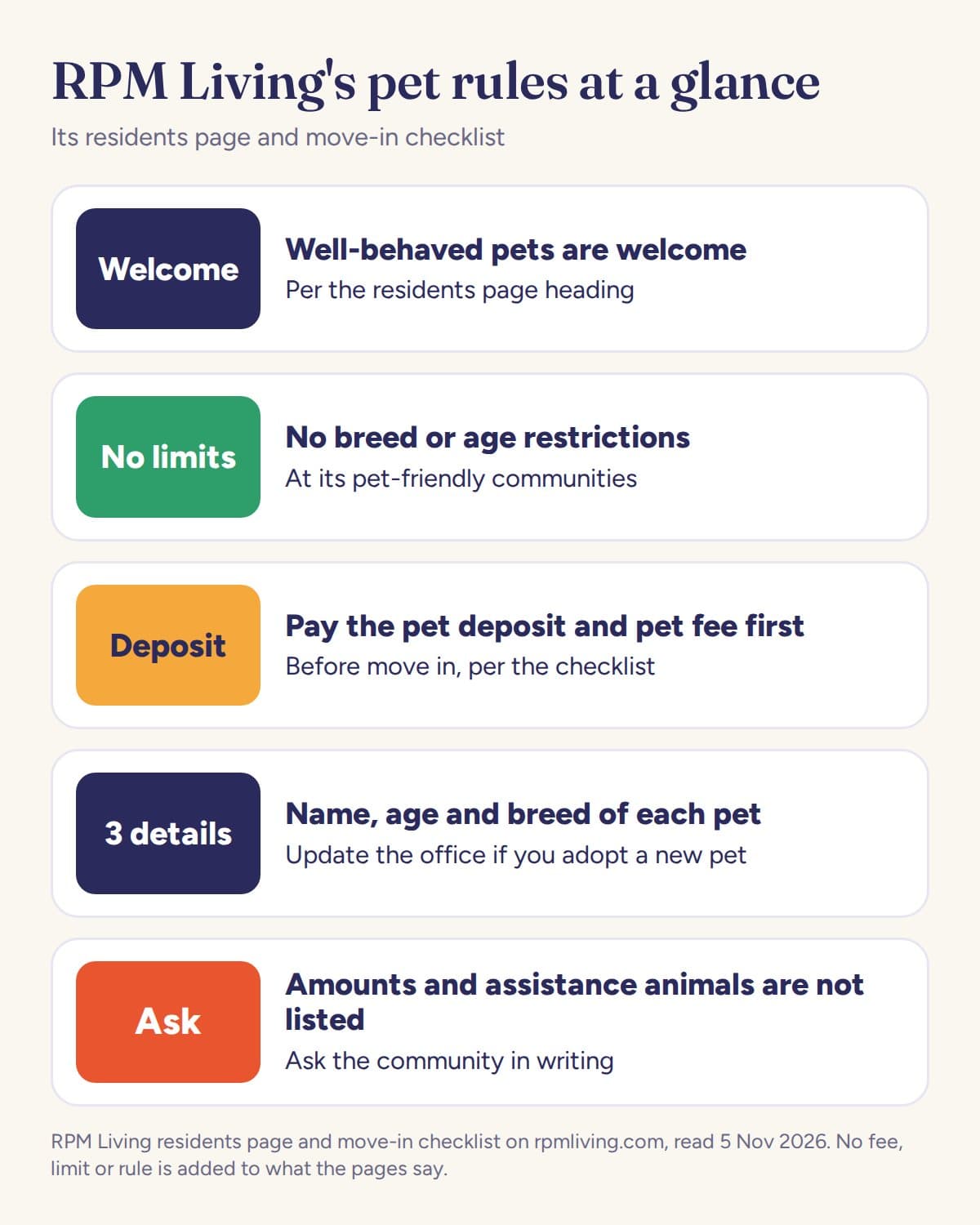
| The question | What RPM Living's pages say |
|---|---|
| Are pets welcome? | The heading reads "WELL-BEHAVED PETS WELCOME." |
| Are there breed or age limits? | "Our pet-friendly communities have no breed or age restrictions." |
| What must be paid before move in? | "The pet deposit and pet fee," under the heading "Pay Pet Deposit (if Applicable)." |
| What does the office need to know? | The pet's "name, age, and breed." |
| What about a new pet after move in? | "If you adopt a new pet after moving in, please be sure to update our office with your new pet information." |
| How much are the deposit and fee? | Neither page gives an amount. |
| What about assistance animals? | Neither page mentions service animals, assistance animals or emotional support animals. |
Does RPM Living allow emotional support animals?
Neither RPM Living page we read mentions emotional support animals or assistance animals, so its answer has to come from the community you are applying to. The "no breed or age restrictions" line sits in a section about pet-friendly communities, so the questions below go to the leasing office in writing:
Ask the community
The pages give no assistance animal process, so the leasing office is the one to ask.
Ask for the process
No request form, document list or deadline is on either page, so ask for each.
Ask how it is counted
The checklist is written for pets, so ask whether an assistance animal is covered by the same steps.
Ask about the charges
The checklist names a pet deposit and a pet fee, so ask whether either applies.
Give your companion the card
Register your emotional support animal in about 3 minutes. Your Certificate of Registration and digital ESA Card arrive by email as two print-ready PDFs, backed by a 30-day guarantee.
About 3 minutes · Instant digital delivery
30-day money-back guarantee, no questions asked.Does RPM Living charge a pet deposit for an assistance animal?
RPM Living's move-in checklist names a pet deposit and a pet fee "if applicable," gives no amount, and does not say whether either applies to an assistance animal. Ask the leasing office in writing which charges, if any, apply, and keep the answer. HUD's own statement on fees is below.
How do you ask RPM Living for an emotional support animal?
RPM Living publishes no request process on the pages we read, so the request starts with a written message to the community's leasing office. Five steps keep it clean:
- Contact the community's leasing office before the animal moves in.
- Ask for its assistance animal request process and any form it uses.
- Put your request in writing and keep a copy of everything you send.
- Give a letter from your provider when the community asks for documentation.
- Ask in writing whether a pet deposit or fee applies, and keep the answer.

What do HUD's own documents say about an emotional support animal at an RPM Living community?
The Fair Housing Act covers RPM Living like any other landlord, and HUD's own statement says a housing provider may ask for reliable proof of the disability and the need, but may not charge extra fees or deposits for an accommodation. HUD and the Justice Department's joint statement on reasonable accommodations, dated May 17, 2004 and still on hud.gov when we read it, says a provider "may request reliable disability-related information" when a disability is not obvious, and that "housing providers may not require persons with disabilities to pay extra fees or deposits as a condition of receiving a reasonable accommodation." It adds that a tenant can still be billed for damage the animal causes. RPM Living's move-in checklist names a pet deposit and a pet fee and does not say whether either applies to an assistance animal.
HUD has since changed how it enforces this. It withdrew its 2013 and 2020 assistance animal notices, effective September 17, 2025, and since May 22, 2026 its fair housing office pursues an animal complaint only when the animal is trained to do disability-related work or tasks (HUD's enforcement memo). The Fair Housing Act itself, your right to go to court and state laws did not change, and a 2025 federal decision attached to the memo found that waiving one $400 animal fee was not required on its facts, so fees are decided case by case. Our page on HUD's emotional support animal rules has the documents, and our guide to pet deposits, pet rent and fees for an ESA has the cases.
What should an ESA letter include when you give it to RPM Living?
A letter from a licensed provider who evaluated you and can be reached, on letterhead with their license number and a signature, gives a leasing team something it can check. Our free sample ESA letter shows each part, and our guide to who can write an ESA letter covers which licenses count. The quickest route is a therapist, psychiatrist or doctor who already treats you, because they know you and can confirm the letter if RPM Living calls. The RPM Living pages we read do not list the documents it asks for, so ask the community what it needs to see. The checks anyone can run on a letter are in how to verify an ESA letter.
No provider of your own? In Florida, New Jersey and New York we can book you a live video evaluation with an independent therapist licensed in your state: $120, with $80 back if they can't approve you, and the therapist alone decides on the letter. You can book in Florida, book in New Jersey or book in New York.

Other managers publish different rules. Our guides to Bell Partners, Avenue5 and Asset Living read each company's own pages the same way, our study of what 16 large landlords publish about emotional support animals counts all sixteen, and our guide to how PetScreening reviews an ESA request covers the screening service many properties use.
Alongside the letter, ESA Card registration gives your animal a digital ESA Card with its photo, a certificate and a number anyone can check at esacard.com/verify, for $39$59$79$99 once, in about three minutes. It is handy for the everyday questions; the letter from your provider is the document a housing provider can ask for.
Your pet, on your phone
The part you actually carry
An ESA letter goes in your lease file. The ESA Card is the everyday one: your animal's photo, a certificate for the wall, and a registration number anyone can check. $39$59$79$99 once, about three minutes.
About 3 minutes · Instant digital delivery
30-day money-back guarantee, no questions asked.Keep reading