Guides
How to Register a Dog as an Emotional Support Animal (2026 Guide)
No government registry exists, so registering a dog means getting the letter that carries legal weight and, if you want one, an ID card for everyday use. Here are the five steps, in order.

On this page
There is no government registry for emotional support animals, so registering a dog means two separate things: getting the letter that gives you housing rights, and, if you want one, an ID card for everyday use. This guide walks through both in order, and says plainly what each one does and does not do.
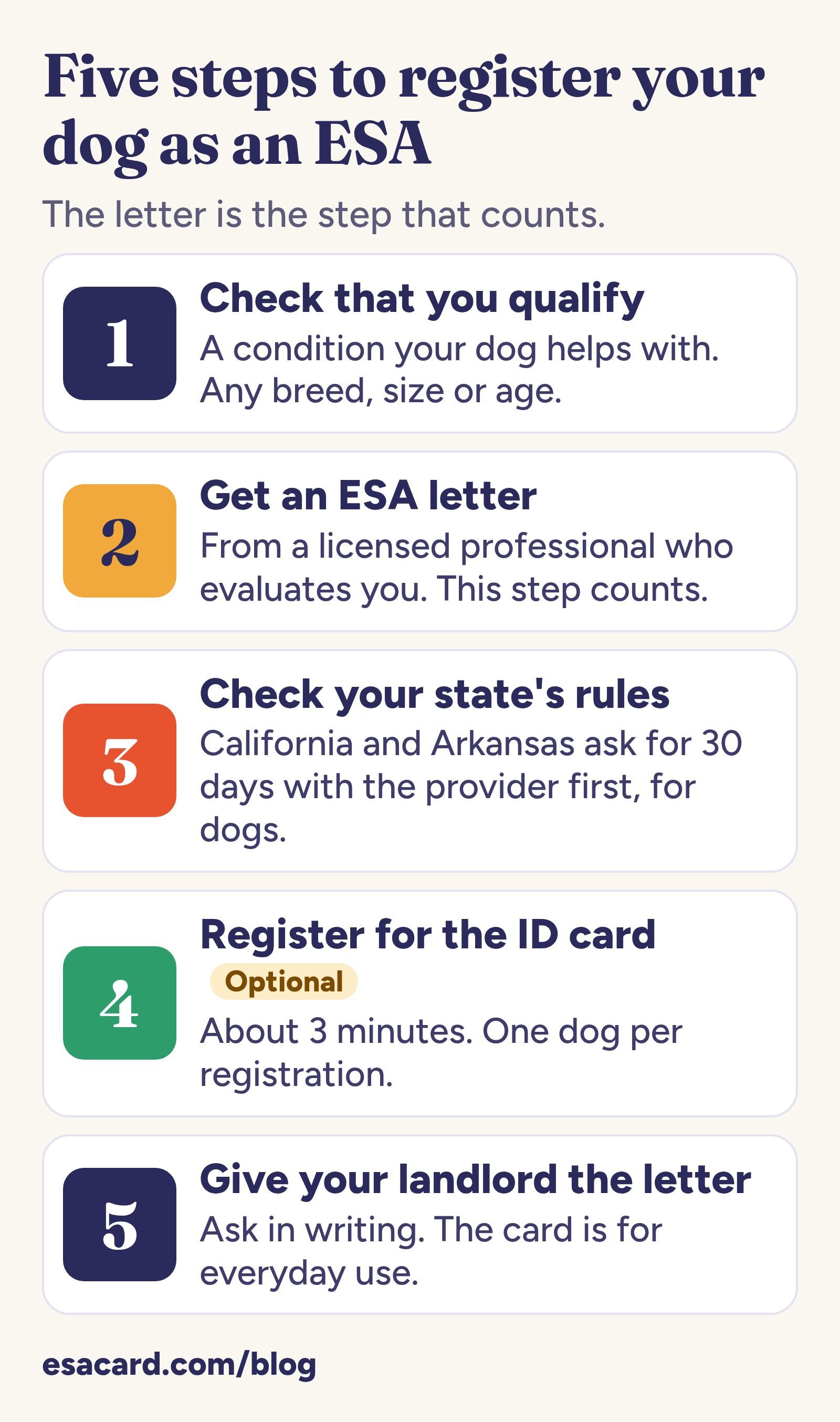
Here are the five steps to register your dog as an emotional support animal
- Check that you qualify. An ESA is about your need, not your dog's résumé: you have a mental or emotional condition, such as anxiety, depression or PTSD, and your dog helps with it. Any breed, size or age of dog can be an ESA, and there is no training or test.
- Get an ESA letter from a licensed professional. Ask your own therapist, psychiatrist or doctor first, since many write one as part of your care, and hand them our free sample ESA letter so they know what a landlord expects. No provider? Book an evaluation with a licensed professional in your state (more on that below). The letter is the one document that carries weight.
- Check your state's rules. California and Arkansas add a 30-day relationship with the provider before a letter for a dog, and Louisiana and Montana do the same for any animal. Everywhere else, one real evaluation is enough.
- Register your dog, if you want the ID card. Go to /register with your dog's name, breed, birthday and a photo, plus your name, city and email. It takes about 3 minutes and costs $39$59$79$99 for the Digital Kit. This step is optional, and it gives you no legal rights.
- Give your landlord the letter, in writing. Send the letter with your request to live with your dog, and keep a copy. Use the card for everyday things, never as a replacement for the letter.
An emotional support dog is a pet that helps you with a mental or emotional condition
An emotional support animal, or ESA, is an animal whose company eases the symptoms of a mental or emotional disability. The dog does not have to do anything special: being there is the support. Comforting you through a panic attack, getting you out of bed on a hard morning and breaking a spiral of anxious thoughts all count. What the law looks at is your condition and the dog's place in managing it.
Any breed, size or age
The law sets no breed, size or age for an ESA dog. A building or a state may have its own rules, covered below.
No training and no test
No class, no temperament test and no trainer sign-off is required for an emotional support dog.
The evaluation is about you
A professional looks at your condition and how the dog helps with it, not at the dog's manners.
Housing is where the rights are
That is where an ESA letter has real weight. Planes, stores and workplaces work differently.
An emotional support dog is not a service dog or a therapy dog
These three get mixed up all the time, and the difference decides where your dog may go. Under the Americans with Disabilities Act, a service animal is a dog individually trained to do work or perform tasks for a person with a disability, and the rule says that providing emotional support, comfort or companionship does not count as work or tasks. An emotional support dog is the other kind: no tasks, just support.
| Emotional support dog | Service dog | |
|---|---|---|
| What it does | Comforts you by being with you | Performs trained tasks for your disability |
| Training | None required | Trained to do work or tasks |
| Housing | A Fair Housing Act request, backed by a letter | A Fair Housing Act request, and the stronger one under HUD's 2026 memo |
| Stores and restaurants | No ADA right of entry | Allowed wherever the public goes |
| Flying | Flies as a pet | Can fly in the cabin under DOT rules |
| Paperwork | An ESA letter | None required by the ADA |
A therapy dog is a third thing again. It is usually a family pet that, with its owner, visits hospitals, schools and nursing homes to comfort other people, often through a group that tests it first. A therapy dog has no housing or public-access rights of its own and goes where a facility invites it. Our ESA vs service dog page sets the first two side by side in more detail.
The letter from a licensed professional is the paper that counts
Any licensed mental health professional or physician who is licensed in your state and has evaluated you can write it: a therapist or counselor, a psychologist, a psychiatrist, a licensed clinical social worker, a psychiatric nurse practitioner, or a doctor. A veterinarian cannot, because the letter is about your health, not the dog's. Our guide to who can write an ESA letter covers each credential.
Start with a provider who already treats you, because they know the condition the letter documents. No provider? In Florida, New Jersey, New York and Ohio, ESA Card's live video evaluation with a licensed therapist is $120; elsewhere, a legitimate telehealth service with clinicians licensed in your state typically charges $139 to $199. Before you pay anyone, check three things: the clinician is licensed in your state, a live evaluation actually happens, and the letter carries a license number a landlord can look up. A promise of an instant letter with no evaluation is the sign that no clinician is involved.

A good letter shows five things
- It is on the clinician's letterhead, signed and dated.
- It gives their license type, number and state, which is what a leasing office checks.
- It says you have a condition that substantially limits a major life activity. It does not need to name your diagnosis.
- It says the dog helps with that condition, ideally naming the dog.
- It comes from a clinician who actually evaluated you, not a form filled in by the website.
Four states add rules on timing, and two of them are written around dogs. California (Health & Safety Code § 122318) and Arkansas (Ark. Code § 20-14-1003) require a 30-day relationship with the provider before they document an emotional support dog, and Arkansas also wants a yearly evaluation. Louisiana and Montana require 30 days for any animal. Everywhere else, one real evaluation is enough. Our state law table has all fifty, and the longer guide to an ESA letter for a dog covers what those two dog laws ask of the letter.
Registration and an ID card are optional, and here is what they are for
No law asks you to register an emotional support dog, and registration does not create housing rights, ours included. HUD's 2020 notice, since withdrawn, said that certificates bought online do not by themselves show a disability-related need, and its withdrawal gave them no new weight. So what is a registration good for? Everyday convenience: a card with your dog's photo and a number anyone can look up is easier to show a pet sitter, a building manager at the door or a vet than a letter you would rather keep private.
| ESA letter | Registration and ID card | |
|---|---|---|
| Who gives it | A licensed professional who evaluated you | A private registry. No government runs one |
| What it is for | A housing request | Everyday use, with a number anyone can look up at /verify |
| Needed for housing | Yes | No |
| Typical cost | Often $0 from your own provider, or $139 to $199 online | $39$59$79$99 for the Digital Kit |
Say your dog is Oscar, a Golden Retriever. Registering him takes about 3 minutes at /register: his name, breed, birthday and a photo, then your name, city and email. No health questions, no evaluation and no waiting. The Digital Kit ($39$59$79$99) arrives by email at once: a Certificate of Registration with Oscar's name and a digital ESA Card with his photo, as two separate print-ready documents, each showing a registration number you can check at /verify. It includes 12 months on the verification listing, and one kit covers one dog, so a second dog needs a second kit. The Complete Kit ($69$89$109$129) adds the card and certificate printed and mailed to United States addresses. Both are on the pricing page, and every kit has a 30-day money-back guarantee.
Give your companion the card
Register your emotional support animal in about 3 minutes. Your Certificate of Registration and digital ESA Card arrive by email as two print-ready PDFs, backed by a 30-day guarantee.
About 3 minutes · Instant digital delivery
30-day money-back guarantee, no questions asked.The Fair Housing Act is where an emotional support dog has rights
The Fair Housing Act requires a landlord to make reasonable accommodations in their rules when a person with a disability needs one, and courts have long read that to cover emotional support animals. So a no-pet building still has to consider your request to live with your dog, and many landlords waive the pet fee and any breed or weight limit when they get a letter. Rules differ by state and by building, so ask yours for its policy in writing.
The ground moved recently, so two cautions. HUD withdrew its written guidance on assistance animals effective September 17, 2025, and since May 22, 2026 its fair housing office pursues an animal complaint only when the animal is trained to do disability-related work. The Fair Housing Act itself, your state's laws and your right to go to court did not change. Our page on what HUD changed in 2026 has the details.
Your landlord can still say no to a specific dog that is a documented danger, and you pay for any damage your dog does. A few homes sit outside the Act altogether, such as some single-family houses rented by their owner without a broker. If yours says no, ask for the reason in writing and take it to your state or local fair housing agency.



Here is what to say when a landlord asks for a registration number
This is where most people get stuck, and the answer is short. There is no government registry for emotional support animals, so no landlord can require a number from one. What a landlord can look at is the letter.
I don't have a registration number, because no government registry exists for emotional support animals. I do have a letter from my licensed provider, which is the documentation the Fair Housing Act points to. A copy is attached.
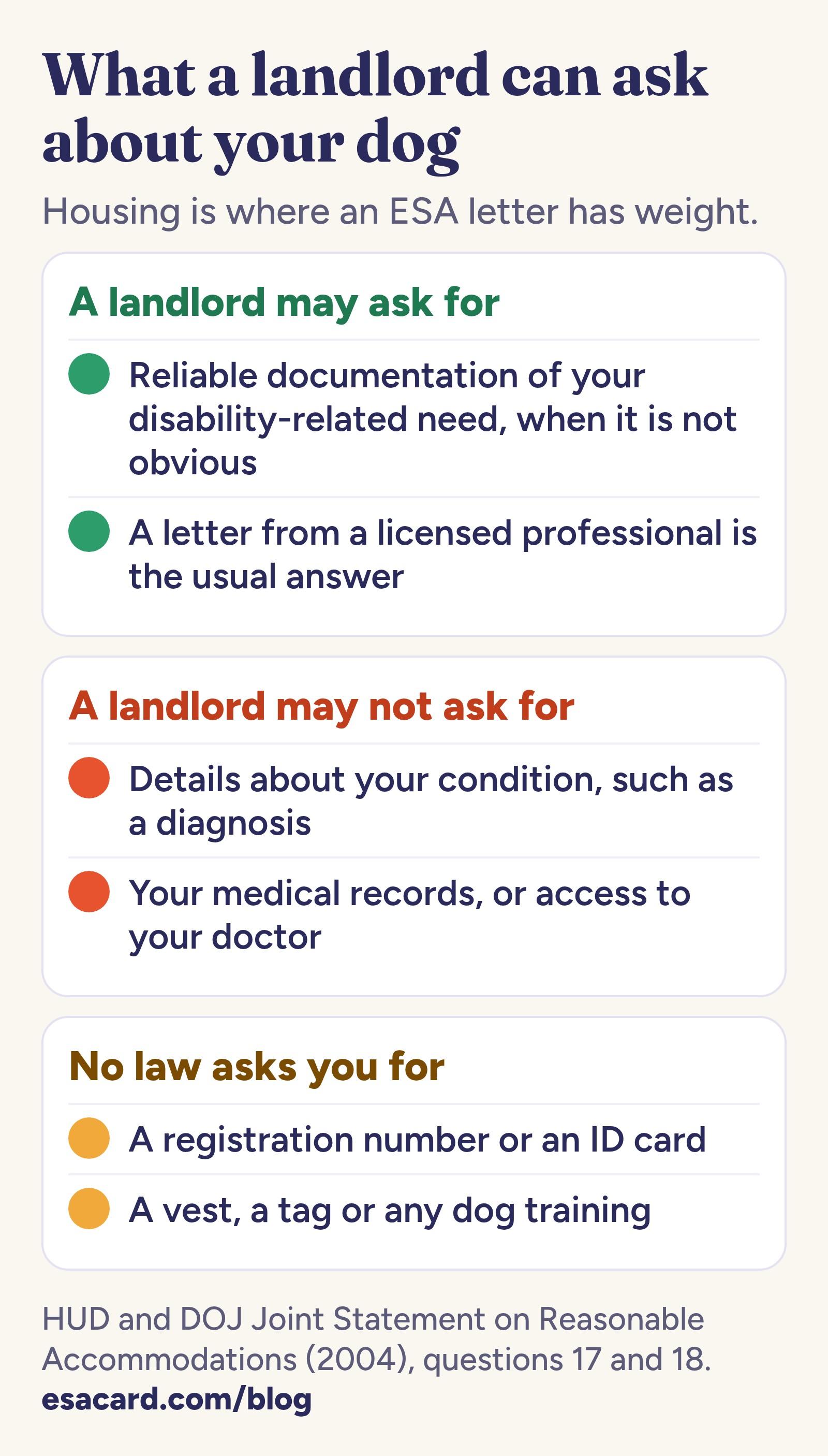
A landlord may check that the letter is real and that the clinician's license is active, and our guide on how to verify an ESA letter shows how that check works. You do not have to share your diagnosis or your medical records. If you also hold a registration, you can mention it, but lead with the letter.
Airlines no longer have to take an emotional support dog, and stores do not either
Flying
Since the DOT's rule took effect in January 2021, airlines may treat an ESA as a pet, with a carrier and a pet fee. Only trained service dogs have air travel rights.
Stores and restaurants
The ADA covers service dogs, not emotional support animals, so a business can say no to an ESA. Some state and local laws differ, as the ADA's own FAQ notes.
Work
The ADA sets no rule about which animal an employer must allow. Your employer decides case by case when you ask for it as an accommodation.
Home
Housing is the one place an ESA letter has real weight, which is why it is the step that counts.
Your dog still needs the license and rabies shot that every dog needs
Being an emotional support dog does not replace the rules that apply to every dog where you live. Most cities and counties require a dog license, and rabies vaccination for dogs is required by state or local law almost everywhere. Your city or county animal services office can tell you what yours asks for, and a leasing office will often ask to see both.
Watch for sites that promise things a registration cannot deliver
- Access to every store, restaurant or hotel. No registration or certificate creates that right for an emotional support dog.
- Free flights or cabin seats. Airlines may treat an ESA as a pet, whatever paper you hold.
- An instant letter with no evaluation. A real letter comes from a licensed clinician who has spoken with you.
- A listing in an official government registry. None exists, in any state.
- A guarantee that your landlord will accept it. Nobody can promise that.
Give your companion the card
Register your emotional support animal in about 3 minutes. Your Certificate of Registration and digital ESA Card arrive by email as two print-ready PDFs, backed by a 30-day guarantee.
About 3 minutes · Instant digital delivery
30-day money-back guarantee, no questions asked.Bottom line: get the letter from a licensed professional first, because it is the paper a landlord looks at, and add the card if it would make daily life with your dog easier. You can register your dog in about 3 minutes for $39$59$79$99, or see the emotional support dog registration page with the card and certificate before you pay. The same steps work for registering a cat, and our guide on how to make your dog an emotional support dog goes deeper on the letter. For every kind of animal, start at emotional support animal registration.